Wednesday, July 20, 2016

Delhi is Going Off the Track by Banning Old Vehicles and Allowing for More Newer or Secondhand Vehicles


The National Green Tribunal’s (NGT) crusade to improve the quality of Delhi’s air has very often meant a single point agenda: Clamping down on diesel vehicles. In April last year it had said diesel vehicles older than 10 years should not ply on the city’s roads. The green body’s directions created confusion for authorities in Delhi while it did precious little to improve the city’s seriously polluted air. The Delhi Traffic Police and the RTO were confounded as to who would implement the tribunal’s orders and the police found out that issuing challans did not deter diesel car drivers from bringing their vehicles back on the road. The NGT has now asked the RTO to de-register all diesel vehicles that are more than 10 years old.

See what's polluting Delhi?

There is no quarrel with the contention that diesel vehicles pollute. However, the extent to which diesel vehicles are responsible for Delhi’s bad air is open to debate. An IIT- Kanpur study notes that they are responsible for only 2 per cent of Delhi’s pollution. Other studies, including those by environmental groups, cite a higher figure. However, given the grave proportions that pollution in Delhi has assumed, corrective measures are called for. The significance of the NGT’s directive should be seen from that perspective. And it’s here that the green body’s directive fails to hit the right target. While on paper, it may mean that thousands of vehicles could go off the road, it’s anybody’s guess if that will happen in reality. Earlier bans have failed in their objectives. Vehicle owners could well find it convenient to register their 10-year-old automobiles elsewhere in the NCR — Gurgaon or Noida, areas not bound by the NGT’s directives.

Delhi’s traffic anyhow does not comprise only vehicles registered in the city. Commercial as well as personal vehicles from the NCR — as well as other states — ply on Delhi’s roads. The court order does not distinguish between vehicles used for personal purposes and those that transport necessities. There is also the danger that the order may mean that Delhi will be transporting its pollution elsewhere. The aged vehicles from the capital may find their way to second-hand car markets in other parts of the country, especially smaller towns — that are not doing too well on the pollution front. Tackling Delhi’s pollutions requires a long-term vision, that also encompasses regulating diesel vehicles. Such vehicles can be phased out. But knee-jerk reactions like bans will do more harm than good.

Read the full article @ the Indian Express

Fighting Motorcycles and Waiting for Metro Lines in Hanoi

Hanoi, a city with more motorbikes than households, has to contend with heavy congestion and frequent traffic accidents. In recent years, studies have named it among the worst cities in Asia for air pollution. In May this year, Vietnamese media reported that the US embassy’s air quality monitor in Hanoi registered a “hazardous” spike in particulate matter, reportedly reaching a level seven times that recommended by the World Health Organisation.

Though the government hopes the metro can tackle both traffic and environmental issues at once, the project has faced numerous delays and setbacks. What’s more, convincing Hanoians to give up their motorbikes could turn out to be the biggest challenge yet.

In 2008, more than 80% of journeys in the city were carried out by motorbikes and scooters – and a fast-growing share of the population is opting for cars. Currently there are roughly 4.9 million motorbikes and scooters on Hanoi’s roads. The use of bicycles, once the dominant transport mode in the city, decreased dramatically as motorbikes and cars became more popular: in 1995, 47% of journeys were made by bicycle; in 2008, the figure had dropped to only 3%.

Hanoi’s Transport Plan aims to increase the share of public transport from the current low figure of 9% of trips, to above 60% by 2030, by which time Hanoi is slated to have six new metro lines and three Bus Rapid Transit (BRT) lines. But the ambitions get even steeper. Last month, Hanoi’s Party Committee outlined plans to ban motorbikes from the downtown area by 2025, in line with improved public transport. A total downtown ban of the vehicles would require a huge lifestyle shift for most residents – and put an enormous amount of pressure on the new metro system. None of the locals I speak to regard the 2025 plan as feasible.

Read the full article @ The Guardian


Infographic - Understanding Road Transport Emissions in Delhi


Tuesday, July 12, 2016

Managing Air Pollution in Teheran

The working group is comprised of ministers of interior, oil, transport, industry, energy, and economy, as well as directors of the Management and Planning Organization and the Department of Environment, governor of the Central Bank, police chief, and mayors of the targeted municipalities. Approved by the cabinet of the ministers, the working group is tasked with monitoring, coordinating and taking measures to implement a comprehensive plan to mitigate air pollution in the country. In line with the plan to abate the air pollution, the Central Bank of Iran is also demanded to pay a 22-trillion-rial (nearly $630 million) loan with 20 percent interest rate to finance Iran’s one-year clunker replacement scheme. It’s been some years Tehran and some other metropolises such as Isfahan are struggling with air pollution all year round. The pollution appears in different shapes and forms. Once they are particles less than or equal to 10 or 2.5 micrometers in diameter which sometimes are caused by hotspots located either outside or inside the country that cripple the cities mostly located in southern and western Iran and makes it difficult for the citizens to breathe. It is not easy to respond to these dust storms right away as they usually need to be dealt with on international level. In other cases they are resulted from the cars which usually are considered as clunkers that are abundant in the country and partially responsible for the air pollution as well. There are some scrappage schemes for such cars in Iran as well and some banks also finance them.

Read the full article @ the Tehran Times

Friday, July 08, 2016

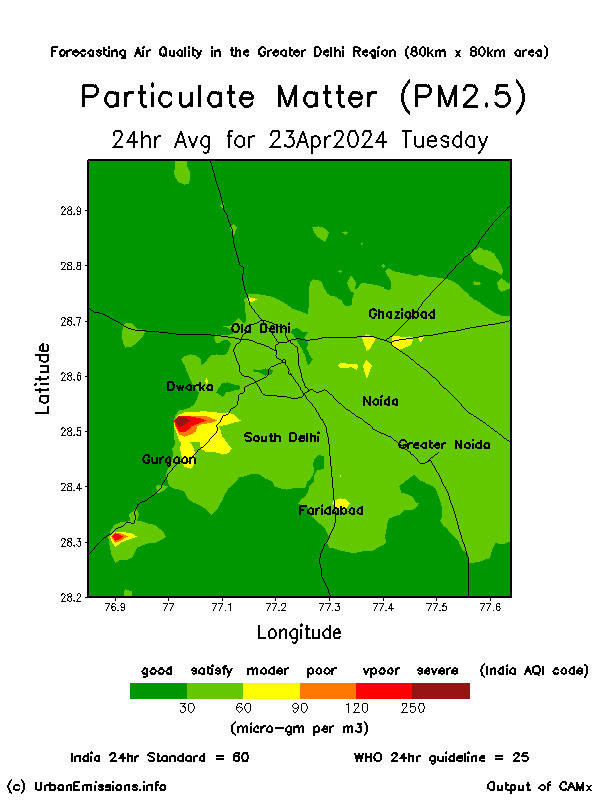
Air Quality in Agra (Forecasts, Updated Everyday)

This is modeled air quality for India in forecast mode. The reports for all the 640 Indian districts are updated everyday @ India Air Quality.Info


See what is happening at the regional scale, which is conducted as part of the all India air pollution forecasting program, hosted @ http://www.indiaairquality.info. The animation below is from a WRF-CAMx simulation conducted @ 0.25x0.25 degree resolution (approximately, 25km x 25km).

Taxing Diesel Vehicles in UK for Pollution Control

The “diesel-gate” scandal of last year, in which Volkswagen was revealed to be rigging emission tests, has focused public and policy maker attention on the issue of harmful emissions from diesel vehicles. Since the late 1980s, diesel cars and vans have made up an increasing proportion of new vehicles sold in Britain and across the European Union. In the UK they now represent almost four in ten cars on the road, compared to closer to one in 20 in the early 1990s.

The move to diesel, an area in which European car manufacturers have always had an advantage over their America and Japanese rivals, was strongly encouraged by policy makers through tax incentives and environmental regulations at both the national and the European level. There was a perception that, although diesel was known to have a bigger impact on air quality than petrol, it produced fewer carbon emissions and a switch to diesel would help slow climate change.

Since then three things have fundamentally changed. Advances in hybrid and electronic cars have produced a form of mass transport which avoids a trade-off between climate change and air quality, the emissions scandal has shown that this trade off may have always been worse than assumed, and there has been a growing recognition that increased NOX levels from diesel vehicles are creating what has been called a public health emergency. In the UK alone, air pollution is contributing to 40,000 to 52,000 premature deaths annually.

This is the background to a new policy report produced for Green Budget Europe (GBE), the campaigning organisation fighting to shift taxation away from labour and on to pollution both in Britain and in Europe. It was launched at a roundtable assembled by Prospect in collaboration with GBE.

Read the full report @ Prospect Magazine

Wednesday, July 06, 2016

Coal Dust Responsible for 23,000 Premature Deaths in EU

Coal dust is responsible for about 22,900 premature deaths per year in the E.U., according to a report released Tuesday. This report is the first analysis to show how coal dust travels, damaging the health in countries hundreds of kilometers away. In addition to premature deaths, coal plants were responsible for 11,800 new cases of chronic bronchitis and 21,900 hospital admissions in 2013. The premature deaths were linked to three main pollutants: particulate matter, ground-level ozone, and nitrogen dioxide. Particulate matter, known as PM, caused 83 percent of premature deaths from various causes such as stroke, heart disease, chronic lung disease, or lung cancer.


Read the full article @ Think Progress

South Korea is Retiring 10 Coal-fired Power Plants

The Korea government said it will shut down 10 aged coal-fired power plants in the coming 10 years and no longer build new ones as part of its efforts to reduce air pollution and tackle worsening fine dust emissions. The Ministry of Trade, Industry and Energy said that it will close 10 coal stations aged 30 years or over, with a combined capacity of 3.3 million kilowatts, one by one when they reach the end of their respective operational life span.

Two power plants on the country's west coast will face the first shutdown in 2018, with the closure program to be completed by 2025. "We will not allow new coal plants to be built in the country," said Deputy Trade Minister Chae Hee-bong said in a briefing. "Only renewable green energy power stations will produce electricity in the country." The outdated coal plants have been singled out as the main culprits of fine dust, along with old diesel vehicles. Out of 53 coal power plants operating in South Korea, 10 are over 30 years old.

Coal-powered electricity accounted for 28 percent of the country's total power production in 2015, following by nuclear power with 33 percent. The government will inject 2 trillion won ($1.73 billion) to help retrofit eight coal generators aged 20 year old or over to improve their efficiency and reduce sulfuric acid emissions. The remaining 35 plants will be equipped with desulfurization system, added the ministry.

The plan details the follow-up measures to the Korean government's efforts unveiled last month to control fine dust which has recently emerged as one of the biggest threats to public health, as the country has increasingly become more dust-polluted. Trade Minister Joo Hyung-hwan said the latest plan will decrease fine dust by 24 percent by 2030.

Read the full article @ the Korean Herald

How Air Pollution Effects Your Health?

Exposure to air pollutants has been linked to suppressed lung growth, asthma, heart disease, foetal brain growth damage and the onset of diabetes. 


Air pollution from traffic and industry is leading to the premature death of more than three million people a year. Globally, that’s more than malaria and HIV/Aids combined. Pollutants including nitrogen dioxide and particulate matter from road traffic and sulphur dioxide, from the burning of fossil fuels, have been linked to suppressed lung growth in children, asthma, heart disease and the onset of type 2 diabetes. The exposure of pregnant women to air pollution has also been found to affect to foetal brain growth.

It is an avoidable and unequal health burden. In London, for example, more than 400 schools are located in areas that exceed limits for nitrogen dioxide pollution, but four-fifths of those are in deprived areas. Even in countries with a long history of tackling air pollution, the problem has not gone away. The UK, which passed its first anti-air pollution legislation 60 years ago today, is currently involved in a long-running legal battle over its failure to cut pollution to legal levels.

This infographic (posted @ the Guardian) helps explain the main pollutants and their health impacts.

Saturday, July 02, 2016

Air Pollution is a Major Cause of Heart Attacks in Karnataka

“Inhaling polluted air is nothing but urban smoking, and is as bad as smoking. The incidence of heart attacks is three to five times more in smokers than in non-smokers,” said Ajit Mullasari S., director of cardiology, The Madras Medical Mission, Chennai. He was speaking at press meet to announce the launch of STEMI (ST-Elevation Myocardial Infarction) India programme for Karnataka, aimed at speedy diagnosis and treatment of heart attack patients in rural areas. Dr. Mullasari attributed the increasing incidents of heart attack among the young to urbanisation and rising pollution levels in cities.

While treatment for heart attack is one of the most challenging emergencies for a doctor, if it is treated promptly and appropriately, it can result in significant reduction in death and disability, said Thomas Alexander, head of the department of cardiology at Kovai Medical Centre and Hospital.

The State-run Jayadeva Institute of Cardiovascular Sciences will be a major player in developing the heart attack management programme for Karnataka under STEMI. Institute director C.N. Manjunath said the programme will initially take off in Bengaluru, Mysuru and Kalaburagi districts. The programme has been running successfully in Tamil Nadu for the last three years, and was started in Telangana last year, Dr. Manjunath said, adding that it would be rolled out in Karnataka in the next two months. To train doctors to manage heart attacks and help hospitals develop ‘Heart attack teams’ to efficiently manage high-risk patients, STEMI India is conducting a two-day training programme in the city from Saturday.

Read the full article @ the Hindu

Taxing Diesel Cars Based on NOx Emissions in UK

The report outlines options for government and city authorities to cut NOx emissions from new diesel cars through tax-based measures. The average diesel car currently sold would be charged £1,100 to £1,700 if a NOx-based registration tax is adopted. Options are also detailed for city-based charges, with a focus on London, although the lessons may be applied to other cities heavily affected by air pollution, including Birmingham, Leeds, Southampton, Derby, and Nottingham.

The level of the proposed national charge is based on the amount of NOx emitted, and so encourages carmakers to clean up new vehicles. Applied at registration, the charge can be introduced and work alongside the reform of the CO2-based Vehicle Excise Duty in April 2017.

Turning to cities, the report details options for the parallel introduction of NOx-related road pricing, including integration to existing and planned charging schemes. Reform to company car taxation and ‘benefit in kind’ rules for diesel cars are also proposed. Finally, the report outlines how revenue generated may be used.

For further details, the full report by Green Budget Europe can be found here.

Waste from Delhi to be Used for Highways Construction

Solid waste from Ghazipur mandi in the national capital will be used in construction of highways, while plans are afoot for landscaping of two peripheral expressway projects worth Rs 8,037 crore, Union Minister Nitin Gadkari said today.

“Eastern and Western bypasses, which the government plans to build in 400 days will be the first pilot projects and architects will design beautification of these. This will involve landscaping and other works,” the Road Transport and Highways Minister said here on the sidelines of an event to launch plantation drive under National Green Highways Mission.

Prime Minister Narendra Modi had laid the foundation stone of these two projects last year with a combined length of 271 km last year. The minister also said that to minimise pollution in Delhi, NHAI will utilise the waste from Ghazipur in construction of highways. The famous Ghazipur mandi, which supplies vegetables and fruits to a large portion of Delhi and adjoining areas, is known as a major contributor to air pollution in the region because of the landfill gases from the garbage dump caused by the waste from the market. 

NHAI is already utilising fly-ash up to 30 per cent of earth filling in the Eastern Peripheral Expressway and using other slag materials elsewhere. Gadkari said the government had entrusted the assignment of technically verifying whether Solid Waste Material generated from Municipal/city waste can be utilised for highway construction to Council of Scientific and Industrial Research (CSIR)-Central Road Research Institute (CRRI). Earlier CSIR and CRRI had conducted a study by collecting 70 tonnes of municipal solid waste from different locations of 5/10/15 years old from Ghazipur Land fill site of Municipal Corporation of Delhi.

Read the full report @ Indian Express

Friday, July 01, 2016

Overcrowded Sidewalks in New York City


While crowding is hardly a new problem in the city, the sidewalks that cemented New York’s reputation as a world-class walking city have become obstacle courses as more people than ever live and work in the city and tourism surges. The problem is particularly acute in Manhattan. Around Penn Station and the Port Authority Bus Terminal, two of the city’s main transit hubs, commuters clutching coffee cups and briefcases squeeze by one another during the morning and evening rushes. Throngs of shoppers and visitors sometimes bring swaths of Lower Manhattan to a standstill, prompting some local residents to cite clogged sidewalks as their biggest problem in a recent community survey.

Foot traffic has slowed to a shuffle along some of the city’s most famous corridors. On Fifth Avenue, between 54th and 55th Streets, 26,831 pedestrians — enough to fill Madison Square Garden and Radio City Music Hall combined — passed through in three hours on a weekday in May 2015, up from 20,639 the year before, according to city data.

Transportation officials are taking measures to alleviate the congestion. To help accommodate foot traffic, they are adding more pedestrian plazas across the city, expanding the presence of a streetscape feature first embraced by the administration of Mayor Michael R. Bloomberg. One is scheduled to open soon on 33rd Street near Penn Station. There are also plans to widen a half-dozen sidewalks in Flushing, Queens, in the next year (the city’s sidewalks vary in width, but must be at least five feet wide).

While a crowded sidewalk is simply a symptom of a crowded city, it resonates deeply because it affects almost everyone. Unlike overstuffed subways or tourist attractions like, say, Times Square, there is no going around the sidewalks. They are to New York what freeways are to Los Angeles: an essential part of the infrastructure. Sidewalks not only get people from Point A to Point B, but also serve as a shared public space for rich and poor, native and tourist alike.

Read the full article @ the New York Times