Showing posts with label Bus Rapid Transport. Show all posts

Thursday, August 04, 2016

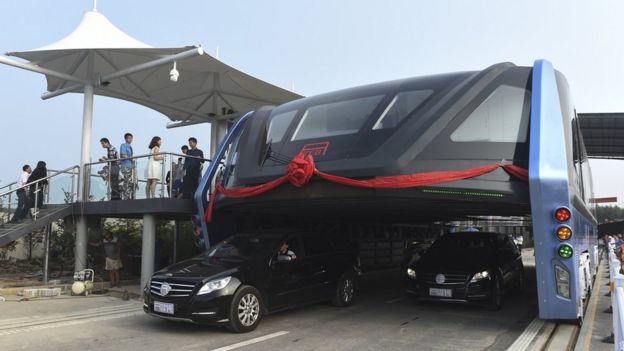
China's Elevated Bus: Futuristic 'Straddling Bus' Hits the Road


The 2m-high Transit Elevated Bus (TEB) straddles the cars below, allowing them to pass through. Powered by electricity, the bus is able to carry up to 300 passengers in its 72ft (21m) long and 25ft wide body. A video of a mini-model of the vehicle caused great excitement when it was released in May.


The trial run was conducted on a 300m-long controlled track in the north-eastern city of Qinhuangdao. The vehicle is expected to reach speeds of up to 60km per hour, running on rails laid along ordinary roads. Up to four TEBs can be linked together. "The biggest advantage is that the bus will save lots of road space," the project's chief engineer, Song Youzhou, told state-media agency Xinhua earlier this year. "The TEB has the same functions as the subway, while its cost of construction is less than one fifth of the subway," another engineer Bai Zhiming told news outlet CCTV.


One TEB could replace 40 conventional buses, according to the firm. However, it is unclear when the vehicle will be widely used in Chinese cities. It is not a new idea, but it was not seriously considered until a mini-model of it was launched at the 19th China Beijing International High-Tech Expo in May. A month later, developers announced that the TEB would be ready for a test-run in August. Thousands took to micro-blogging site Weibo to express their amazement and incredulity.

full article @ BBC

Friday, July 22, 2016

For Public Transportation, Hanoi Wants to Ban Bikes by 2025

Vietnam’s government plans to rid the congested streets in downtown Hanoi of motorbikes by 2025 to make room for more buses and metro lines — but residents areless than open to the change.

There are currently around half a million cars and 5 million motorbikes on the Hanoi streets, and the government estimates that economic growth will increase those numbers to 1 million cars and 7 million motorbikes by 2020. The streets are already crowded, and air pollution is bad enough that the Real Time Air Quality Index classifies the city as “unhealthy.”

“The traffic situation in Hanoi will become extremely complicated in the next four to five years,” Hanoi City Chairman Nguyen Duc Chung said at a public development meeting. “So we really need a timely solution to this.”


That solution includes building highway, bridges, tunnels, bus stations, along with doubling the number of buses and adding six new metro train lines by 2030. But it also includes banning motorbikes from the city center within ten years. In a city where less than 10 percent of residents use public transportation, the transition would be extreme.

In addition to not wanting to part with an integral mode of transportation, The Guardian reports that some see the move as unfair to those who cannot afford their own cars. Many are skeptical that the construction of the first two new metro lines will happen on schedule by 2020, since they have already faced delays.

Wednesday, July 20, 2016

Fighting Motorcycles and Waiting for Metro Lines in Hanoi

Hanoi, a city with more motorbikes than households, has to contend with heavy congestion and frequent traffic accidents. In recent years, studies have named it among the worst cities in Asia for air pollution. In May this year, Vietnamese media reported that the US embassy’s air quality monitor in Hanoi registered a “hazardous” spike in particulate matter, reportedly reaching a level seven times that recommended by the World Health Organisation.

Though the government hopes the metro can tackle both traffic and environmental issues at once, the project has faced numerous delays and setbacks. What’s more, convincing Hanoians to give up their motorbikes could turn out to be the biggest challenge yet.

In 2008, more than 80% of journeys in the city were carried out by motorbikes and scooters – and a fast-growing share of the population is opting for cars. Currently there are roughly 4.9 million motorbikes and scooters on Hanoi’s roads. The use of bicycles, once the dominant transport mode in the city, decreased dramatically as motorbikes and cars became more popular: in 1995, 47% of journeys were made by bicycle; in 2008, the figure had dropped to only 3%.

Hanoi’s Transport Plan aims to increase the share of public transport from the current low figure of 9% of trips, to above 60% by 2030, by which time Hanoi is slated to have six new metro lines and three Bus Rapid Transit (BRT) lines. But the ambitions get even steeper. Last month, Hanoi’s Party Committee outlined plans to ban motorbikes from the downtown area by 2025, in line with improved public transport. A total downtown ban of the vehicles would require a huge lifestyle shift for most residents – and put an enormous amount of pressure on the new metro system. None of the locals I speak to regard the 2025 plan as feasible.

Read the full article @ The Guardian


Monday, December 14, 2015

Car Restrictions in Mexico City and Bogota


Several cities around the world, including Mexico City, Bogota, Sao Paulo and Santiago, have implemented licence-plate restrictions in various forms. Mexico City’s story resembles Delhi, where car restriction was started to counter the extremely high pollution levels in winter. The idea originated when air pollution levels were seen to drop significantly on car-free days, similar to Delhi’s Raahgiri initiative, where small sections of roads are car-free on Sundays. Vehicle restrictions in Mexico City began in 1987 as a voluntary initiative led by an environmental group. By 1989, the metropolitan area of Mexico City was faced with such high levels of atmospheric ozone that the government implemented a programme that banned the circulation of 20 per cent of all private vehicles on each weekday between 5 am and 10 pm. The ban was based on the last digit of the vehicle’s licence plate. Early results were good, with reduced fuel consumption, faster road speeds, etc. However, these gains were shortlived, as by 1995, about 22 per cent people had bought second cars. These second cars became notorious as “chocolate cars” for the colour of their exhaust, as they were cheaper, older, poorly maintained vehicles, bought with the purpose of circumventing the car restriction by those who could afford it.

Interview with Dr. Lucas Davis, Associate Professor at the Haas School of Business at the University of California-Berkeley, on Reuters

Vehicle restrictions were first introduced in Bogota in 1998. Here, 40 per cent of private vehicles were prevented from operating in the city each day between 7 and 9 am and between 5.30 and 7.30 pm. Vehicles having any of four digits as the last digit of their number plate are restricted each day. Over the years, the programme has helped significantly reduce peak-hour congestion in Bogota. While congestion has reportedly worsened in the hours before and after the restriction period, peak-hour travel times have reduced by 40-50 per cent and car users have managed to change their schedules, organise car pools or use taxis. The reason Bogota succeeded where Mexico City struggled was that the initiative in Bogota was accompanied with implementation of the bus rapid transit (BRT) and cycling infrastructure. This ensured that public transport was boosted to deal with the added influx of people and did not choke with the additional pressure.

Tuesday, June 16, 2015

Delhi’s Clean Air Challenge - Slow Murder (CSE Bulletin)

Eitorial by Sunita Narain

It is good that deadly air pollution in Delhi has become national headline. But it is bad that we are failing to deal with it and find answers that are commensurate with the scale of the problem. It is time to understand what we have done and the actions we need to take urgently and decisively. Otherwise, next winter—barely five months away—will be even more severe and hazardous. While foreigners can choose not to live in polluted Delhi, most of us do not have that option. Let’s also be clear that home air purifiers and filters are not the solution even if the rich in the city believe that they can shut their houses and clean their own private air.


Some 16 years ago, the Centre for Science and Environment (CSE) issued an advertisement: “Roll down the window of your bullet-proof car, Mr Prime Minister. The security threat is not the gun, it is the air of Delhi.” This was the time when the air of Delhi was full of black smoke, fuel and emission standards were virtually non-existent and motorisation was just beginning to take off. The agenda for action—also listed by CSE in the public notice—was to advance the roadmap for fuel-emission standards; restrict diesel vehicles and make the transition to a much cleaner fuel, compressed natural gas (CNG).

Not anymore. Since 2007 pollution has risen to dangerously toxic levels. This winter, the level of PM 2.5—tiny particles emitted from vehicles that can go deep into the lungs and enter the blood stream—remained three-four times higher than the safety standard. In fact, in November, December and January, air was classified as “severely polluted” for over 65 per cent of the days. According to the government’s own air quality index, this meant pollution was so bad that it could cause “respiratory effects even on healthy people”. It is unsafe to breathe. This is what we must realise.

So, what has happened to make Delhi residents, once again, wheeze, choke and die because of dirty air? In the past decade, since the introduction of CNG, some things have changed. First, there has been an explosion of personal vehicles—near 100 per cent increase in registration in Delhi alone. So, even as each car has become cleaner because of tighter emission standards and better quality of fuel, the number has increased exponentially. The net result on pollution is the same.

Second, while in 2000 diesel cars were only 4 per cent of the total sales, this increased to 50 per cent by mid-2000. Each diesel car is legally allowed to emit four to seven times more than the petrol variant. Pollution is inevitable. Third, the bypass road, ordered by the Supreme Court in 2004, was not built. So, some 50,000 trucks using dirty fuel and even dirtier technology transit the city.

One new source of pollution has made an entry. Post mid-2000, Punjab and Haryana directed farmers to delay paddy transplantation to reduce groundwater usage in peak summer. Now farmers have no time to prepare the field between harvesting paddy and growing wheat, so they burn the straw. In October and November, just as winter inversion is settling in, smoke from this fire makes its way to the already polluted airshed of Delhi.

The country immediately needs an aggressive roadmap for clean fuel and vehicle technology. This is not acceptable to powerful vehicle manufacturers. Even as oil companies have started the supply of cleaner fuel across north India since April 1, 2015, car companies have succeeded in getting an extension for supply of clean vehicles from the surface transport ministry. Now, the same car companies are busy arguing that they should continue to have the licence to pollute. They want 8-10 years to move to the cleaner vehicle technology Europe uses today. These companies need to understand that we have all run out of time and air to breathe.


The other steps are equally urgent, from monitoring air quality to smog alerts, so that we know when it is advisable to take precautions because of bad air. But most critical is the need to massively augment our public transportation systems, from bus and metro to footpaths and cycle tracks, so that we can take a bus and then cross the road or just walk. We also need car restraints. Parking rates and fines for illegal parking need to be increased and then enforced. Today we have a handful of cranes and a sprinkling of traffic police to stop illegal parking. This cannot go on.

In mid-1990s, we published a report on air pollution and called it Slow Murder. That’s what it is—deliberate and deadly. Nothing less.