
Showing posts with label Air Pollution in Ahmedabad. Show all posts
Showing posts with label Air Pollution in Ahmedabad. Show all posts
Tuesday, February 17, 2026
Air Quality in Ahmedabad in 1600s
Excerpt from the "Book of Emperors" -- air quality in Ahmedabad in 1600s




Sunday, April 13, 2025
Friday, June 16, 2023
Precipitation (rainfall) forecast for Ahmedabad, India (for the next 3 days)

Time series is the variation within the city airshed among the 1-km grid cells. Data is modelled using WRF meteorological model and GFS initiation fields.
For details visit City-level meteorology and air quality forecasts. Other parameters include wind speeds, wind directions, surface temperatures, ground-level temperature, and mixing heights. Updated everyday around 7PM IST.
Monday, June 05, 2023
Precipitation (rainfall) forecasts for the next 3 days - Ahmedabad, India
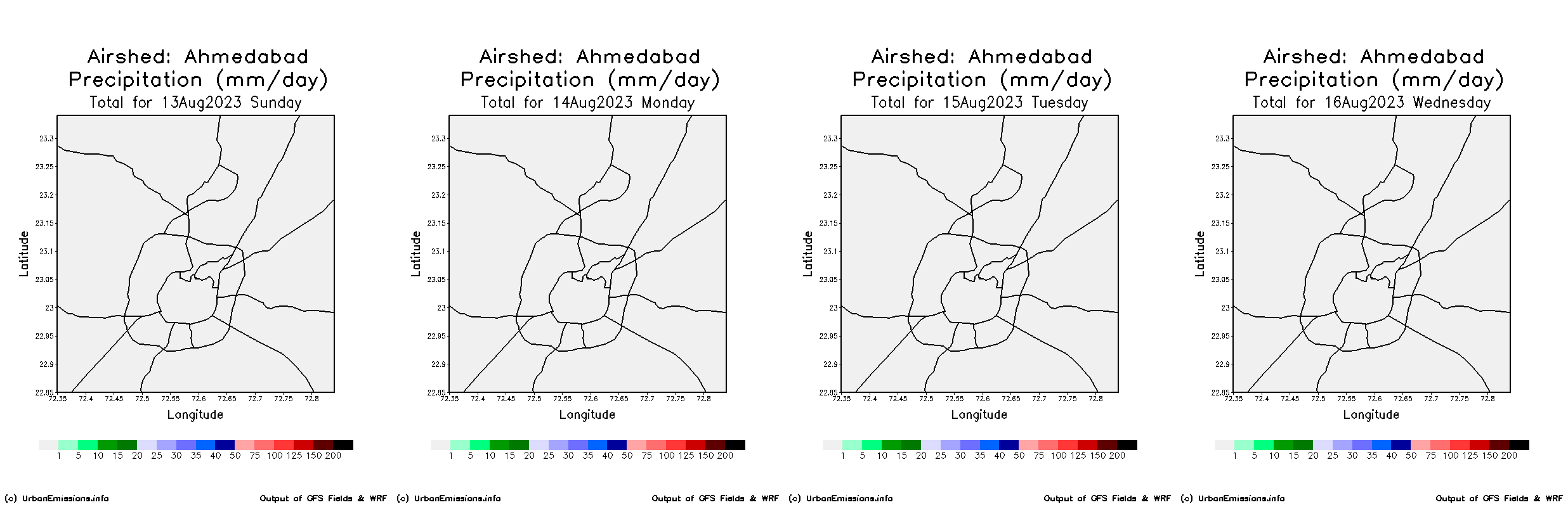
For details visit City-level meteorology and air quality forecasts. Other parameters include wind speeds, wind directions, surface temperatures, ground-level temperature, and mixing heights. Updated everyday around 7PM IST.
Thursday, December 08, 2022
Wednesday, July 21, 2021
Wednesday, March 17, 2021
Thursday, December 15, 2016
Air Pollution in Ahmedabad

To develop the program, the Ahmedabad Municipal Corporation Commissioner Shri Mukesh Kumar and Mayor Shri Gautam Shah joined by international public health and air pollution experts from the Indian Institute of Public Health-Gandhinagar (IIPH-G), Natural Resources Defense Council (NRDC) and the Indian Institute of Tropical Meteorology, Pune (IITM) are holding a two day workshop on “Air Pollution & Health: Laying the Foundation for Effective Use of Ahmedabad’s Air Quality Index” this week.
NRDC and partners, IIPH-G, are working with the AMC on information, education, and communication strategies for the new AQI being launched in Ahmedabad. The combined efforts of government agencies, health professionals, and community leaders can serve to effectively inform the public about rising air pollution health risks in India, and how to take steps to protect community and individual health.
The new Ahmedabad program focuses on air quality alerts and advisories, interagency coordination, public awareness and community outreach, and assessing health impacts and monitoring to strengthen actions. The interagency coordination, alerts, and outreach are modeled on the effective Heat Action Plan by the city that has now scaled to 11 cities in 2016 and potentially leading states in the coming year.
The new program is also designed to integrate health and pollution control strategies with the Gujarat Pollution Control Board’s “City Clean Air Plan for Ahmedabad”. The GPCB includes a broader comprehensive strategy for emissions controls. The program will also incorporate knowledge exchange components with New Delhi and other cities. Ahmedabad is examining media strategies used in New Delhi on health risk communication and outreach to design its program.
Read the full article @ NRDC
Sunday, May 22, 2016
Ahmedabad Traffic Cops Logging Personal Pollution Exposure Data

The study is being supported by Natural Resources Defence Council (NRDC). "The traffic personnel's kit has a personal air quality sampler, noise dosimeter, and temperature data logger," says IIPH researcher Priya Dutta. Her colleague Abiyant Tiwari adds, "The pollution readings will be taken for 12 days along with the heat logger. It will explain how much pollution a person is exposed to on our city roads," says Tiwari.
Nearly 40 traffic police personnel have been selected for the study after due their consent was taken.
More @ Times of India
Wednesday, October 17, 2012
Application of SIM-air Family of Tools for Air Quality Analysis in Six Indian Cities
Published in Atmospheric Environment
 Abstract
A prerequisite to an air quality management plan for a city is some idea of the main sources of pollution and their contributions for a city. This paper presents the results of an application of the SIM-air modeling tool in six Indian cities – Pune, Chennai, Indore, Ahmedabad, Surat, and Rajkot. Using existing and publicly available data, we put together a baseline of multi-pollutant emissions for each of the cities and then calculate concentrations, health impacts, and model alternative scenarios for 2020. The measured annual PM10 (particulate matter with aerodynamic diameter less than 10 micron meter) concentrations in μg/m3 averaged 94.7 ± 45.4 in Pune, 73.1 ± 33.7 in Chennai, 118.8 ± 44.3 in Indore, 94.0 ± 20.4 in Ahmedabad, 89.4 ± 12.1 in Surat, and 105.0 ± 25.6 in Rajkot, all exceeding the annual standard of 60 μg/m3. The PM10 inventory in tons/year for the year 2010 of 38,400 in Pune, 50,200 in Chennai, 18,600 in Indore, 31,900 in Ahmedabad, 20,000 in Surat, and 14,000 in Rajkot, is further spatially segregated into 1 km grids and includes all known sources such as transport, road dust, residential, power plants, industries (including the brick kilns), waste burning, and diesel generator sets. We use the ATMoS chemical transport model to validate the emissions inventory and estimate an annual premature mortality due to particulate pollution of 15,200 for the year 2010 for the six cities. Of the estimated 21,400 premature deaths in the six cities in 2020, we estimate that implementation of the six interventions in the transport and brick kiln sectors, can potentially save 5870 lives (27%) annually and result in an annual reduction of 16.8 million tons of carbon dioxide emissions in the six cities.
 Abstract
A prerequisite to an air quality management plan for a city is some idea of the main sources of pollution and their contributions for a city. This paper presents the results of an application of the SIM-air modeling tool in six Indian cities – Pune, Chennai, Indore, Ahmedabad, Surat, and Rajkot. Using existing and publicly available data, we put together a baseline of multi-pollutant emissions for each of the cities and then calculate concentrations, health impacts, and model alternative scenarios for 2020. The measured annual PM10 (particulate matter with aerodynamic diameter less than 10 micron meter) concentrations in μg/m3 averaged 94.7 ± 45.4 in Pune, 73.1 ± 33.7 in Chennai, 118.8 ± 44.3 in Indore, 94.0 ± 20.4 in Ahmedabad, 89.4 ± 12.1 in Surat, and 105.0 ± 25.6 in Rajkot, all exceeding the annual standard of 60 μg/m3. The PM10 inventory in tons/year for the year 2010 of 38,400 in Pune, 50,200 in Chennai, 18,600 in Indore, 31,900 in Ahmedabad, 20,000 in Surat, and 14,000 in Rajkot, is further spatially segregated into 1 km grids and includes all known sources such as transport, road dust, residential, power plants, industries (including the brick kilns), waste burning, and diesel generator sets. We use the ATMoS chemical transport model to validate the emissions inventory and estimate an annual premature mortality due to particulate pollution of 15,200 for the year 2010 for the six cities. Of the estimated 21,400 premature deaths in the six cities in 2020, we estimate that implementation of the six interventions in the transport and brick kiln sectors, can potentially save 5870 lives (27%) annually and result in an annual reduction of 16.8 million tons of carbon dioxide emissions in the six cities.
Sunday, July 01, 2012
Press Release: Better Air Quality = Better Cities
27 June 2012, New Delhi – Air pollution is a
serious health issue, and according to the World Health Organization,
particulate matter alone kills 3.1 million people annually worldwide. This is
higher than the average number of people killed in traffic accidents annually.
“With the current trend of urbanization and
motorization, we need to empower cities towards a sustainable air quality
management program - with more stringent standards and more powerful pollution
control boards,” says Parthaa Bosu, CAI-Asia India
Representative. “People flock to cities and this trend worsens air pollution
posing great health risks to the population.”
About 340 million people in India live in
cities and by 2030 this is expected to reach 590 million. India’s
motorization index is currently about a tenth of developed regions like the US
and Europe but is climbing rapidly. Estimates have shown that Delhi is adding
300,000 cars a year. For India as a whole, research shows that the vehicle
population will more than double between 2005 and 2015, from 50 million to 125
million in 10 years. The resulting air pollutants and GHG emissions from these
vehicles contribute to the air pollution problem in most urban cities in India.
To advocate for better air quality for cities,
a series of workshops were conducted in the cities of Pune, Chennai, Indore,
Ahmedabad and Delhi. The sessions
covered all the components of integrated air quality management necessary to
analyse and manage the air pollution in the cities, including tools to develop
an emissions inventory and available management options to command and control
air pollution in the cities.
These workshops are part of the Air Quality
and Climate Change Program of the Clean Air Initiative for Asian Cities
(CAI-Asia). Supported by the Shakti Sustainable Energy Foundation and in
partnership with UrbanEmissions.info, CAI-Asia moves the agenda of air quality
management forward by sharing the results from the
UrbanEmissions.info’s study - Urban AirPollution & Co-benefits Analysis in Six Indian Cities – Pune, Chennai,Indore, Ahmedabad, Surat, and Rajkot. The city workshops included
hands-on training for the SIM-air family of tools.

Dr. Sarath Guttikunda from UrbanEmissions.Info
states, “the program is not meant to advocate a model, but to spread the
concept of knowledge management for air quality management in the cities. This
is a much needed exercise, where the required information in scattered and we
need programs to collate that for an informed decision making.”
Mr. Rajesh Rangarajan, Senior Researcher from Institute
for Financial Management and Research, Chennai, India, quotes, “we are using
the results from the UrbanEmissions.info’s study in Chennai to advise the
Tamilnadu Pollution Control Board on the placement of new air quality
monitoring stations, based on the pollution hotspots and influencing emission
sources like the brick kilns and landfills”.

A
National Air Quality Management Workshop held in June 21 gathered members of
government, civil society, and private sector under the banner for better air
quality for cities. Showing their support for
the air quality advocacy, member secretaries - Shri J.S. Kamyotra and Naini
Jaiseelan noted the importance of air quality as a priority issue in India. Case
studies by representatives from Chennai, Indore, and Pimpri Chinchwad (new
Pune) were also presented.
In his keynote address, Shri J.S. Kamyotra, Member Secretary of the Central Pollution Control Board, highlighted the need for improving monitoring, emission inventories, dispersion modelling, and their application for action plans for cities. Together with research organizations in India, source apportionment studies were conducted by CPCB and MoEF for the period 2006 to 2010.
Monday, March 19, 2012
Wednesday, January 18, 2012
Air Pollution in Ahmedabad
 Silent Killers - This might be the best city to live in India but there are a few black spots that need to be dealt with. One contentious issue is pollution.
Link to the article @ Times of India
Contrary to popular belief, vehicular pollution on city roads and industries emitting black smoke from chimneys are not the only pollutants. According to researchers, there are many more 'culprits' that pollute the air we breathe. Even a brick kiln located outside Bopal or a power plant in Gandhinagar will be capable of polluting the city's ambient air quality.
These are silent pollutants which emit particulate matter of less than 10 micrometers in size (PM10). Power plants, dusty roads and brick kilns are some of the other pollutants.
These factors were highlighted by a study named 'Urban air pollution and co-benefits analysis in India' published recently for six Indian cities, including Ahmedabad, Surat, Rajkot, Pune, Indore and Chennai.
The study was conducted by New Delhi-based research group UrbanEmissions.Info to understand the sources of air pollution in these cities and also projected pollution rate in 2020. As per the study, all six cities exceed the annual ambient standard of 60 ug/ m3 (micrograms per cubic meter) of PM10.
In 2003, the city was branded as the most polluted in the country. Since then many changes have been made like introduction of CNG autorickshaws and BRTS. But, the PM10 threat is yet to be addressed effectively. The researchers say that BRTS and its cycle track could hold the key to resolving this issue in future.
Sarath Guttikunda, founder of UrbanEmissions.Info who also developed statistical tools for the project told TOI, "Ahmedabad has a high level of PM10. Here, pollution comes from a variety of sources - power plants and brick kilns surrounding the district. We often believe that vehicles moving in immediate surroundings contribute to the pollution in cities. However, a plant or a kiln away from the city can also affect Ahmedabad considering the wind direction."
Guttikunda added, "While Chennai has almost the same size and more industries, sea breeze blows PM10 away from the city, reducing the suspended particulates in the air. Going by the PM10 levels in Ahmedabad, the estimated premature deaths due to pollution is likely to be 4,950 as compared to 3,950 in Chennai."
The Pollutants
The five main pollutants responsible for majority of the health hazards in Indian cities are particulates (PM), sulfur dioxide (SO2), nitrogen oxides (NOx), carbon monoxide (CO), and ozone (O3). According to the study, consequences of exposure to these pollutants range from premature mortality to aggravated morbidity effects such as respiratory problems, asthma, chronic bronchitis and oxygen deficiency in blood.
The Solution
As per the study, the need of the hour is an air quality management plan which looks at a mix of policies to promote public transport, walking and cycling, improve efficiencies of industries, power plants, and brick kilns, and controls dust on the roads, for better air quality in the cities.
The study also highlighted the fact that a better transport system such as BRTS and less dependency on open burning for cooking or waste disposal is expected to reduce pollutants in air. While Ahmedabad emitted 35,100 tons of PM10, it is expected to decrease a bit in a decade and reach to 31,800 in 2020, says the study
****
Update: December, 2012
A journal article is now published in the Atmospheric Environment
Subscribe to:
Posts (Atom)