Showing posts with label Air Pollution in Bengaluru. Show all posts

Thursday, October 31, 2024

Thinking Air Purifiers Will Solve Air Pollution Problem is Disingenuous and a Waste of Important Resources


There are many ideas to improve air quality. Some of them have been tossed around for a couple of decades now. An action plan the Central Pollution Control Board (CPCB) published in 1997 found its way after 20 years into the hands of the Delhi government.

These are not overnight solutions. They include improving infrastructure, urban transport and solid waste management. As a result, it requires patience, long-term planning, interdepartmental cooperation and, most importantly, joint action by all political parties, since the implementation and outcomes can have a considerable time lag. All straightforward – but not simple to pull off.

This is why technological gimmicks that promise overnight improvements without any reduction in emissions, systemic policy changes or infrastructural improvement are bound to be disingenuous, and a waste of important resources. And this is exactly what the multiple proposals to install air purifiers at intersections to reduce ambient air pollution are.

We cannot improve air pollution by sucking pollutants out of the atmosphere. The only way to control pollution is by controlling pollutants entering the atmosphere – i.e. by controlling emissions.

Full article @ theWIRE

Monday, June 05, 2023

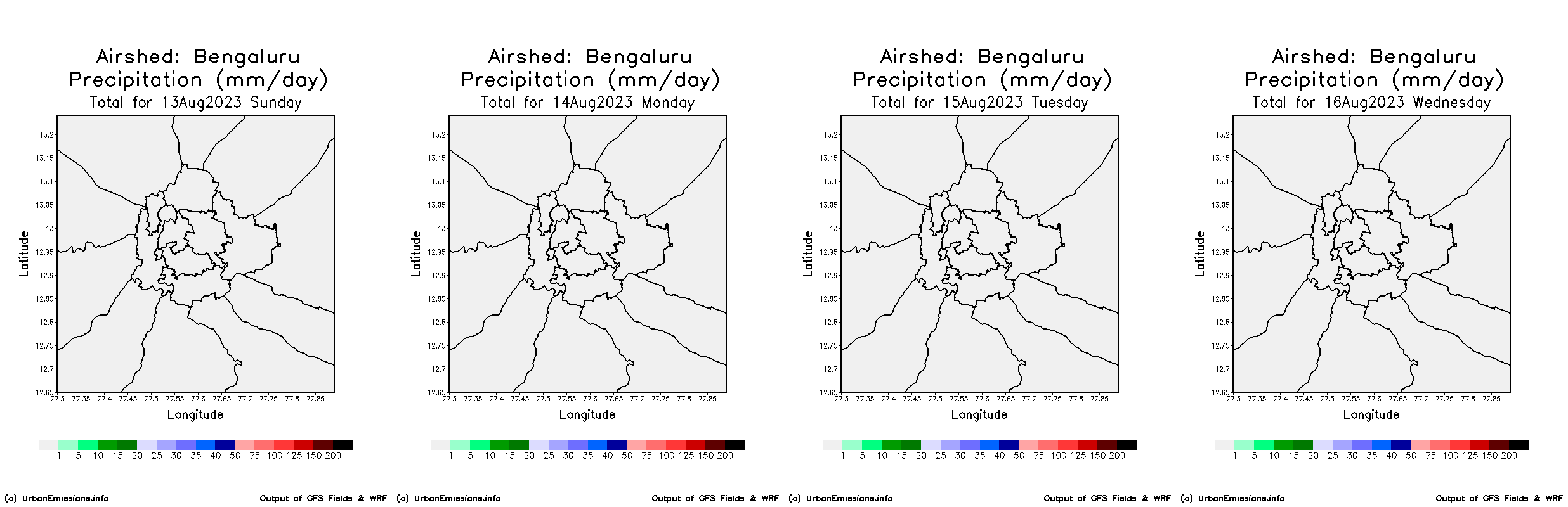
Precipitation (rainfall) forecasts for the next 3 days - Bengaluru, India


For details visit City-level meteorology and air quality forecasts. Other parameters include wind speeds, wind directions, surface temperatures, ground-level temperature, and mixing heights. Updated everyday around 7PM IST.

Monday, December 19, 2016

Karnataka Government Asks Farmers to Stop Burning Sugarcane Trash

As part of its smoke-management strategy, the Karnataka government has issued a diktat to farmers: Stop burning sugarcane thrash in the fields. The move comes in the backdrop of the recent Delhi smog which was fuelled by the burning of paddy straw in the neighbouring states of Punjab and Haryana. In fact, the soaring pollution levels and falling visibility levels in the National Capital Region had not only set alarm bells ringing a fortnight ago but also triggered a blame game between the Delhi government, the neighbouring states and the Centre. The practice of burning sugarcane residue is rampant in at least ten districts across Karnataka.

Taking a cue from the Delhi episode, Karnataka has got into a prevention mode. Agriculture minister C Krishna Byregowda has commenced talks with farmers' groups. He has instructed the agriculture department's field units to stop farmers from burning crop residue. An acre of sugarcane produces around 4,000 tonnes of thrash. With sugarcane being grown on 12 lakh hectares in the state, the sugarcane residue is said to be around 50 lakh tonnes.

The agriculture department shot off a letter on December 12 to all chief executive officers of sugarcane-growing districts explaining the emergency. The missive stated: "Burning residue is not just a loss to agriculture but also pollutes environment and causes ailments and deaths. Air pollution in India causes more than 1,500 premature deaths per day; this is more than one death per minute. For 12 lakh acres of sugarcane in Karnataka, it amounts to burning 48 lakh tonnes of valuable organic matter. This will emit tens of thousands of toxic pollutants into the air." The department wants sugarcane farmers to use technology and convert the waste into manure.

Read the full report @ Times of India

Thursday, November 10, 2016

Tracking Pollution in Bengaluru

To understand rising air pollution and study its impact on public health, urban environment, and its causality, ‘Breathe Bengaluru’, a project for assessment of the city’s air quality, is currently being undertaken in BTM layout. Breathe Bengaluru is taking a bottom up, ‘people first’ approach to tackling air pollution, bringing in multi-disciplinary perspectives and public participatory mechanisms. It is a joint venture of 'Sensors without Borders' and ‘Sensing Local', both Bengaluru--based organisations working on environmental issues such as air and water pollution, waste management among others.

Sensors Without Borders, is a Karma Corps initiative that leverages commodity sensing technologies, devices and systems to collect high quality, bottom-up environmental data in the air and water domains to effect on-the-ground change. Sensing Local is a practice of architects and urban planners with a core focus on making cities healthier, safer and more inclusive. Researchers and experts working on traffic patterns, air quality, technology, urban planning and transport planning, as well as local communities that are an integral stakeholder, will come together under this project to provide suggestions, guidance and analysis of potential linkages between traffic emissions, air quality and health outcomes. -

Read more @ Citizen Matters

This is modeled air quality for India in forecast mode. The reports for all the 640 Indian districts everyday @ India Air Quality.Info