Sunday, August 03, 2014

Delhi to Introduce More Buses in the City


We said it many times, that Delhi needs at least 3-4 times the current fleet. A commentary on air pollution in Delhi in EPW. Now an article below in Hindustan Times saying, Delhi plans to buy 11,000 more buses to meet the public transport demand.

Public Transport in Delhi has a Long Way to Go !!


The Delhi government has drawn up a plan to boost public transport by buying buses, building depots and asking Delhi Metro and Northern Railways to augment their services and provide last-mile connectivity. Prepared after a World Health Organisation report called Delhi the world’s most polluted city in May, the plan looks to reduce vehicular congestion and rising pollution by augmenting public transport.

Enrique Penalosa at the TEDCity2.0 Talking About the Importance of Buses and Public Transport in the Cities


A high-powered committee on pollution control formed by Delhi’s Lieutenant Governor Najeeb Jung has admitted that the existing depots do not have parking space for the current fleet of buses, while “Delhi plans to buy 11,000 more buses to meet demands”.

50 Children Treated Every Day for Respiratory Diseases in Delhi


The panel, headed by the Delhi chief secretary and has the transport commissioner as one of its members, has suggested building multi-level parking lots at existing depots. “Delhi Transport Corporation will buy 5,500 buses. The Delhi Development Authority and the revenue department will provide land. We will get 5,500 buses to be run in clusters by corporate entities. They will have their parking space spread across the national capital region,” said a panel member. The government has hired Delhi Integrated Multi-Modal Transit System to supervise cluster bus operations.

Top 100 Cities with the Worst Air Quality in the World (WHO, 2014)


The committee has asked Delhi Metro Rail Corporation to have eight coaches in all trains. Of the 208 trains running, 58 have eight coaches, the rest have six. By 2016, 130 trains will have eight coaches, it says. The transport department has been told to formulate strategies for introduction of more non-polluting battery-operated vehicles to provide last-mile connectivity. “We’re also asking Northern Railway to revive its Ring Railway network and integrate it with Metro and other feeder services,” the official said.

Shortage in Bus Manufacturing Leading to Scrapped Buses Plying on the Delhi Roads


The panel has asked the transport department to do a transport-need analysis, starting with Dwarka. “It should induct mini eco-friendly buses of 10-15 seats on purchase-hiring basis to ferry passengers from Metro stations.”Jung has accepted the report and asked officials to work in a mission mode.
While forming the committee Jung had said, “We cannot allow pollution to grow unchecked. It is our moral responsibility to provide a healthy environment to our citizens.” 

A Rough Road For BRT Systems in New Delhi


This is, however, not the first time that such plans are being made. The government and Centre for Science and Environment sometime back made a five-year plan to improve Delhi’s air quality which is yet to be implemented. That action plan called for augmentation of the Capital’s bus fleet to 15,000 from the current 6,200 by 2014 and creation of 17 bus clusters and 4 Bus Rapid Transit corridors by 2016.

Saturday, July 26, 2014

London is Cleaning Up It's Air

Following Zoe Williams’s article on pollution in the capital I’d like to reassure readers that the recent spate of alarmist claims are ridiculous and taken out of context (Welcome to London – the planet’s most toxic town, 8 July). Read more @ the Guardian


Emissions research “has found nitrogen dioxide concentrations on Oxford Street to be worse than they are anywhere else on Earth”, Williams says. Anyone who has visited Beijing, Mexico City or Delhi really knows what bad air pollution looks and feels like. Pollution levels in London are in fact lower than in many other world cities: average levels of nitrogen dioxide (NO2) from monitoring sites near busy roads in Stuttgart, Paris, Munich, Rome and Milan are all higher than those recorded for London.

Some cities place their monitoring stations in vast green parks or traffic-free courtyards, hence the lower figures they report. We do the responsible thing and place our monitoring stations directly in the most polluted roads. Most experts do not rank locations, precisely because of the variability between sites, and as such it’s misleading to talk about a “worst location”.


Even though it was estimated in 2010 that there were 50,000 premature deaths a year in the UK, says Williams, “pollution still isn’t taken seriously as a health issue”. At City Hall we are the first to admit that London’s air quality is not good enough. Buses and taxis are major contributors to air pollution on busy roads, so we’ve retired 900 of the oldest buses, and are putting 1,700 ultra-low emission hybrid buses on our streets. Removing 3,000 of the oldest, most polluting taxis met initial opposition but we have pushed on: from 2018 all new taxis will be capable of zero emissions.

We’ve also been busy making 400,000 homes and public buildings energy-efficient and have established a £20m fund to tackle air quality hotspots.

We’ve reduced emissions of NOx by 20% and particulates by 15% since the mayor was elected, and we have halved the number of Londoners living in areas that break EU limits for NO2. The mayor is now drawing up plans for an ultra-low emission zone from 2020, which no other city has ever proposed. This is expected to more than halve emissions of NOx and dangerous particles.

“The fact that only 2% of [children] cycle to school, compared with 50% in the Netherlands, is attributable to the fact that we don’t take road safety seriously across the country,” says Williams. City Hall has invested millions into reclaiming public space for pedestrians and cyclists. As a cyclist I’ve personally appreciated these changes, and the £1bn investment into cycling, which has seen a 55% increase since the mayor was elected. And with more measures, continuous monitoring and a pollution awareness campaign set to launch this autumn, I hope any reasonable observer would agree that London is in the vanguard of improving air quality.

Friday, July 25, 2014

Coal Shortage for the Thermal Power Plants in Andhra Pradesh


As against the requirement of at least 80,000 tonnes of coal every day, the State is able to get 55,000 tonnes as of now and officials are worried over the prospects if the supply situation worsens further. Senior officials of the A.P. Power Generation Corporation, who are working overtime to ensure supply of coal from conventional sources as well as outside, are keeping their fingers crossed over the availability of the fuel to meet the requirements.

According to officials, the 1,760 MW Dr. Narla Tatarao Thermal Power Station at Vijayawada required 30,000 tonnes of coal, 1,050 MW Rayalaseema Thermal Power Project 15,000 tonnes and the Krishnapatnam thermal power plant 20,000 tonnes on a daily basis to ensure generation at full capacity.

Alarmed over the situation, the State government has dashed of a letter to the Central government seeking allotment of 80,000 tonnes a day to meet the demand of the thermal power plants. The government, in its communication to the Union Coal Ministry, maintained that the State could generate 2,000 MW against the total installed capacity of over 3,000 MW due to shortage of coal. 

Read more @ the Hindu

Wednesday, July 23, 2014

Maps of Methane Leaks in US Cities


New maps from Google reveal the locations of natural gas leaks in U.S. cities and highlight the extent of "fugitive" methane emissions associated with the nation's aging infrastructure. The Environmental Defense Fund partnered with Google Street View to map leaks in the nation's natural gas system, using cars equipped with air-quality sensors that collected millions of readings across Boston, Indianapolis, and Staten Island. The analysis found thousands of methane leaks in highly-populated areas — particularly in Boston, where half of the pipes are more than 50 years old and leaks were detected every few blocks.

Although the leaks did not appear to pose explosion hazards, their prevalence highlights the potential for fugitive methane — a greenhouse gas with an impact 20 times that of carbon dioxide — to contribute to global warming. Read more @ Yale 360

More maps @ EDF

Congestion Pricing Could Work for Beijing (EMBARQ)

China’s capital city of Beijing is already home to 5.4 million cars, the most of any Chinese city. The country’s rising wealth means that this is a trend unlikely to stop. This rapid motorization has led to many city government “quick fixes” aimed at easing congestion problems in the short-term. In Beijing and other cities, these include creating numerous expressways, flyovers, and tunnels throughout the city. But this infrastructure that immediately “fixes” the problem never quite seems to keep up with the mounting number of vehicles on the road for long.

To provide better air quality and faster, safer mobility for its 11.5 million residents, on November 5, 2013, the Beijing launched its “Work Plan for Vehicle Emission Control 2013-2017”. This plan includes lowering car-licensing quotas from 240,000 to 150,000 cars per year, while increasing the annual quota for electric vehicles from 20,000 units in 2014 to 60,000 units by 2017, and creating the charging stations needed to support these vehicles.

Congestion pricing is one of the most contested components of the work plan, but is also one of the potentially transformational moves that will bring sustainable transport investment and equitable mobility to Beijing. The success of congestion pricing will rest on how this new charging scheme is perceived and how its revenue is reinvested in the community.

Read more @ EMBARQ

Sunday, July 20, 2014

Tax Free Electric Vehicles in China, till 2017

China will exempt electric cars and other types of "new energy" vehicles from purchase tax, the government said, as it seeks to reduce pollution and conserve resources. The State Council, or cabinet, said that buyers of new energy vehicles – fully electric, hybrid and fuel cell cars –would not have to pay the levy from September to the end of 2017, according to a statement.

The tax is 10% of the net value of the vehicle, according to state media. "For achieving industrial development and environmental protection, this is a win-win," the state council said in a statement on Wednesday. The exemption applies to imported vehicles as well as domestically produced ones, the statement said, adding the government would compile a catalogue of eligible models.

China has sought to increase ownership of electric and hybrid vehicles to ease chronic pollution and reduce reliance on oil imports, but high prices, lack of infrastructure and consumer reluctance have been obstacles. The government has set a target of having five million new energy vehicles on the streets by 2020.

Read more @ The Guardian

Saturday, July 19, 2014

Expediting Solar Power Projects in Telegana (India)

State government wants to overcome power shortage in the long term. The development follows the recent announcement of the department on its plans to establish solar power projects with a capacity of 1,000 MW to overcome power shortages in the longer term. Read more @ the Hindu

Expediting the process, the Energy department had identified government lands at two locations — a stretch of land in possession of the Industries department near Nagarjunasagar project in Guntur district and another owned by the AP Industrial Infrastructure Corporation at MP Kunta near Kadiri in Anantapur — for setting up the plants. Sources in the Energy Department said teams of officials would be deputed to inspect the locations and prepare a feasibility report at the earliest.

Thursday, July 17, 2014

Waste Management Coming to Gurgaon

 
Sixty villages from Gurgaon district have been short-listed for the implementation of Solid and Liquid Waste Management Project under the Nirmal Bharat Abhiyan (NBA) for the current financial year. The project will help in segregation of solid waste and considerably enhance wastewater treatment capacity and help in generation of recycled water for agricultural and other purposes. Read more @ The Hindu

Deputy Commissioner Shekhar Vidyarthi said only those villages which have won or figured in the list of the Nirmal Gram Puraskar have been chosen for the project. The pilot project for waste management is already underway at Mubarakpur, Hasanpur and Kankrola villages in the district. In Hasanpur and Kankrola, the project is being run by the Institute of Global Development, a non-government organisation, with good results. Mr. Vidyarthi said encouraged by the response to the project in these villages, they have now decided to extend it to other villages.

 
In the first phase, the project will be implemented in 16 villages, including Barmoli, Badshahpur, Devlavas, Ransika, Heraheri, Bhakraka, Maujabad, Mahchana, Bapas and Uccha Majra. Under the project, pits will be dug up under sheds in each village to convert wet waste into manure. Tri-cycles will be hired to collect solid waste from around the village every morning and bring it to the pits for recycling. “The wet waste will then be separated from dry waste like polythene bags, glass, iron and cardboards and can be composted. The separated non-biodegradable waste will be sold to scrap dealers,” said Mr. Vidyarthi, adding that two safai karamcharis will be appointed in each village to collect waste. These karamcharis will be initially paid through the District Rural Development Agency, but later the village panchayat will bear their cost.

Wednesday, July 16, 2014

No More New Ambassador Cars


Last week the Magazine reported that production of India's famous Ambassador car has been stopped due to low demand. The article, which reflected on some of the cars finest and most frustrating features, prompted readers to send us their own memories of the iconic car.

I had the pleasure and pain of travelling in Ambassadors in the 1980s. I remember one journey when the glove box kept on falling open, and while still driving along (at speed) the driver took the keys out of the ignition, leaned over and locked the glove box. Jamie, St Albans, UK

For the me Ambassador is India. I remember as a teenager living in Bombay how keys fitted several cars and they all looked alike. Sometimes you drove off in the wrong one and had to go back and find your own. Lis Homan, Northumberland, UK

The only car I know that could lose a wheel and maintain its inimitable road-holding. In 1980 I lost one outside the Calcutta Zoo swerving to avoid a surging mass of humanity fleeing a torrential storm. The old bus got me home regardless and was back on the road next day. G J Prosser, Toronto, Canada

Read more @ BBC

Tuesday, July 15, 2014

Delhi Traffic Problems Double With Rains

Heavy rains on Sunday in the Capital and adjoining areas not only brought down the high temperature, it also washed away the tall claims of monsoon preparedness made by the civic bodies in Delhi.


Sunday, July 13, 2014

Air Pollution in Indian Cities

Journal Article @ Atmospheric Environment - Nature of Air Pollution, Sources, and Management in Indian Cities.

The global burden of disease study estimated 695,000 premature deaths in 2010 due to continued exposure to outdoor particulate matter and ozone pollution for India. By 2030, the expected growth in many of the sectors (industries, residential, transportation, power generation, and construction) will result in an increase in pollution related health impacts for most cities. The available information on urban air pollution, their sources, and the potential of various interventions to control pollution, should help us propose a cleaner path to 2030.


In this paper, we present an overview of the emission sources and control options for better air quality in Indian cities, with a particular focus on interventions like urban public transportation facilities; travel demand management; emission regulations for power plants; clean technology for brick kilns; management of road dust; and waste management to control open waste burning. Also included is a broader discussion on key institutional measures, like public awareness and scientific studies, necessary for building an effective air quality management plan in Indian cities.

Saturday, July 12, 2014

Public Transport in Delhi has a Long Way to Go !!


The exponential increase in the Capital’s population is also reflected in the number of vehicles registered here. Around 75 lakh vehicles are registered in the city, almost equal to the number of vehicles in three most-populous metros of the country put together. More @ the Hindu

50 Children Treated Every Day for Respiratory Diseases in Delhi


With Delhi expanding in all directions, several business districts have developed in different parts of the city. Moreover, several unauthorised colonies coming up across the city have mixed land use, thus restricting the movement of people to far and wide places as several residents work and live in the same area.

India Should Swtich to Bharat-V, Nation-wide, Soon, for Better Air Quality


However, development of satellite towns like Gurgaon and Noida into commercial hubs has altered transport requirement as people travel to and fro from Delhi to these centres. While the planners have been laying thrust on promoting public transport as the only solution to the transport problems of the city and services like the Delhi Metro have made a positive impact, commuting in the city continues to remain a nightmare.

Role of Transport in Making Cities Green


With the city lacking adequate public transport, people are forced to use private vehicles. As a result, the roads remain choked, many a times leading to road rage incidents. While around 25 lakh people commute by the Delhi Metro everyday, another 45 lakh depend on buses for their travel needs. Experts feel promoting a mass rapid transit system and simultaneous discouragement of personal vehicles is the only solution to the transport and traffic woes of the city.

Shortage in Bus Manufacturing Leading to Scrapped Buses Plying on the Delhi Roads


“With the city having expanded far and wide, a network of fast moving public transport like the metro, with last-mile connectivity, is the only way out. Other means of transport, like bus rapid transit [BRT], also need to be developed both for connecting the missing links as well as creating an alternate transport network, which could come handy in case of any kind of technical failure in facilities like the metro,” said P.K. Sarkar, the head of Transport and Planning Department at the School of Planning and Architecture.

A Rough Road For BRT Systems in New Delhi


“Promotion of public transport without discouraging people from using private vehicles will not solve the purpose. The government needs to introduce measures like steep hike in the cost of vehicle registration and parking charges to make private travel costlier,” Mr. Sarkar added.

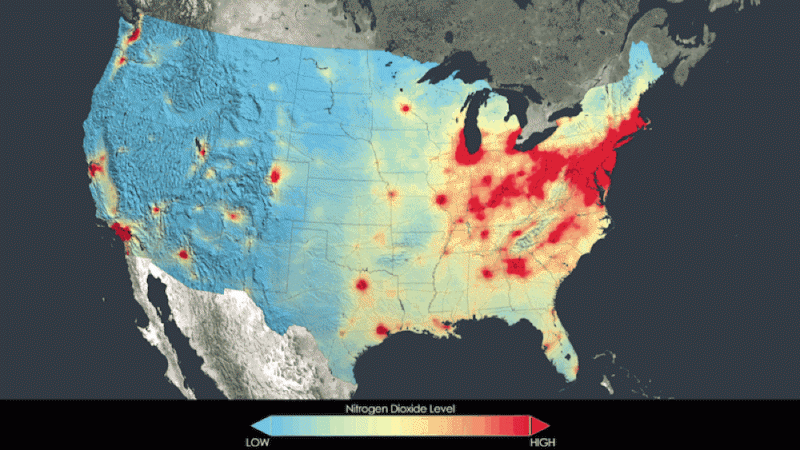
NASA Satellite Images Showing Reduction in NOx Pollution Over Six US Cities


New satellite images recently released by NASA show that air pollution is on the decline in some of the largest U.S. cities. In particular, levels of nitrogen dioxide — a brownish gas linked to respiratory problems — have dropped significantly since 2005, the agency’s scientists say. Read more @ Next City

The gas is produced by gasoline combustion in cars and burning natural gas in power plants. Its decrease at a time when more people are consuming energy and driving cars can be seen as a victory for the Environmental Protection Agency and other agencies that enforce clean air regulations. The progress also indicates that new clean air technologies are helping us shrink our environmental footprint. Still, NASA scientists warn that its still far too soon to begin taking strolls under your local smoke stacks.

“While our air quality has certainly improved over the last few decades, there is still work to do — ozone and particulate matter are still problems,” said Bryan Duncan, an atmospheric scientist at NASA’s Goddard Space Flight Center in Greenbelt, Maryland in a published statement. And while air quality may be improving, power plant emissions of carbon dioxide — a greenhouse gas — remain an unmitigated threat.