Showing posts with label Air Pollution in Dhaka. Show all posts

Wednesday, December 28, 2016

Brick Kilns Blames for >50% of the Air Pollution Crisis in Dhaka


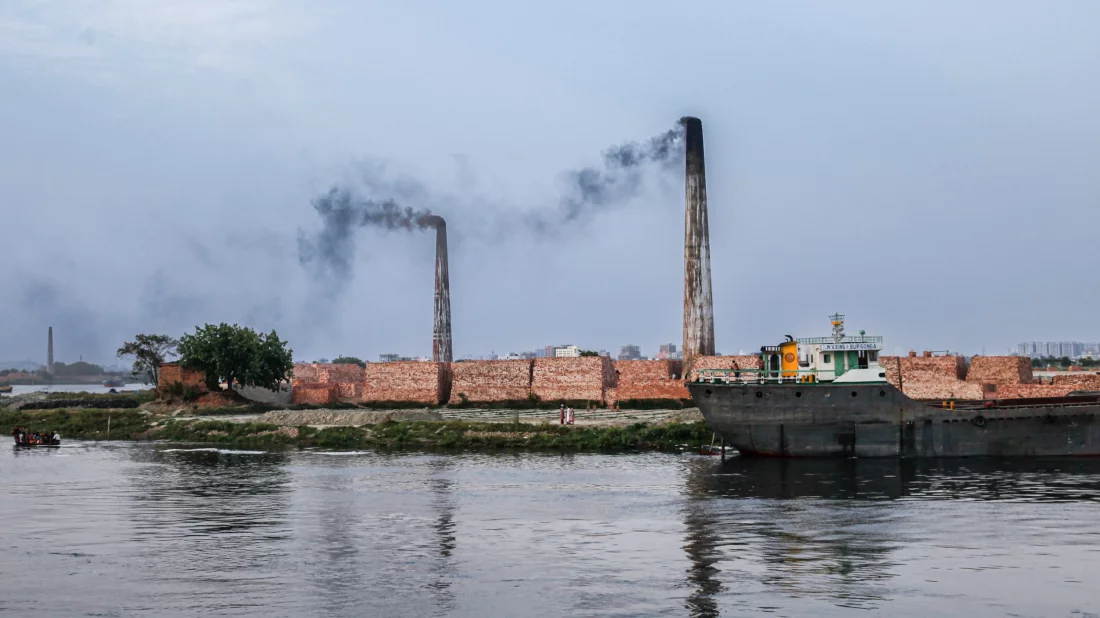
Brick kilns in and around Dhaka city are mostly responsible for the capital city’s air pollution, according to a research conducted by the country’s environment department in association with a Norway-based research institution NILU. Physicians said the polluted air is being inhaled by the city dwellers, entering their lungs and causing different kinds of diseases. According to the research findings, the brick kilns are causing 58 per cent of the air pollution in the city. Other than the brick kilns, dust from the roads and bare soil cause 18 per cent of the pollution, vehicles cause 10 per cent and others sources 14 per cent.

According to another research run by the World Bank on technology use in the Bangladesh brick kilns, shows that the kilns caused 38 per cent of the air pollution in 2011. Comparative study between the two research findings reveals that the air pollution in the city has been increased by 20 per cent in past few years. Bangladesh Poribesh Andolon (BAPA) joint secretary Sharif Jamil told Prothom Alo that brick kilns around the Dhaka city are primarily responsible for the air pollution as a high level of sulphur is being used in the kilns. The owners are being allowed to use coal in their kilns without testing the sulphur level.  Bangladesh brick manufacturing owners association secretary general Md Abu Bakar said there are more than 1000 brick kilns in and around the city. The level of pollution can be reduced with the use of a water sprinkler above the chimney. Abu Bakar said, as the technology is expensive, the owners are reluctant to use it.

According to a study of the Asian Development Bank (ADB), 2 lakh 32 thousand square feet of land is required for a brick kiln. This is taking over agricultural land. Bangladesh Environmental Lawyers Association (BELA) chief executive Syeda Rizwana Hasan said, “We should think of an alternative mechanism to replace this technology.” She also said the brick kilns are prime sources of greenhouse gas in the country. Brick kilns produce an approximately 8.7 million tonnes of greenhouse gas each year that burn 2.2 million of tonnes coal and 1.9 million tonnes of firewood.

Read the full article @ Prothom Alo

Tuesday, September 13, 2016

Air Pollution in Bangladesh Costs $2.6 Billion Annually

Deaths caused by air pollution cost Bangladesh economy nearly $2.6 billion in foregone labour output in 2013, which accounts for 0.58% of its GDP, says a new World Bank Report. The amount compares with $1.2 billion in 1990 and the total number of air pollution-related deaths, causing human suffering and reducing economic development, rose to 27,452 from 6,379 in the 23 years to 2013.

While pollution-related deaths strike mainly young children and the elderly, premature deaths also result in lost labour income for working-age men and women. The study, released on Thursday last, says air pollution robs nations of significant potential to grow, which after being calculated through total ‘welfare losses’ and loss in labour output, reaches a staggering amount especially for developing countries.

Between 1990 and 2013, the total welfare losses in Bangladesh stood at $27.5 billion, making up 6.5% of its GDP. The annual labour income lost from pre-mature deaths by air pollution in Southeast Asia accounted for 0.83% of the region’s GDP in the same year.  The aggregate cost of premature deaths was more than US$5 trillion worldwide in 2013. In East and South Asia, welfare losses related to air pollution were the equivalent of about 7.5% of GDP. In 2013, China lost nearly 10% of its GDP, India 7.69%, while Sri Lanka and Cambodia each lost roughly 8%, as a result of pollution-related deaths.

Read the full article @ Dhaka Tribune

Saturday, June 18, 2016

Rajshahi (Bangladesh) - the City That Took on Air Pollution – and Won

Once, Rajshahi’s sweltering summers were made worse by a familiar problem on the Asian subcontinent: windows would have to be shut, not because of the wind or monsoon, but because of the smog. Dust blown up from dry riverbeds, fields and roads, and choking smog from ranks of brick kilns on the edge of town helped to secure the place a spot in the top tier of the world’s most polluted cities.

Then suddenly Rajshahi, in Bangladesh, hit a turning point so dramatic that it earned a spot in the record books: last year, according to UN data, the town did more than any other worldwide to rid itself of air particles so harmful to human health. Rajshahi does not have a large industrial area, and it is too poor to have streets clogged with cars. Instead, Haque believes it was the campaign to clean up the brick kilns, as well as efforts to make the city greener, that have turned the tide.

Levels of larger PM10 particles went from 195 micrograms per cubic metre in 2014, to just 63.9 in 2016, a reduction of about two-thirds, and the largest in the world in absolute terms. Smaller PM2.5 particles have been nearly halved to 37 micrograms per cubic metre from 70. Nowadays it’s a different city, thanks to the campaign that began with a tree-planting drive more than 15 years ago, and now encompasses everything from transport to rubbish collection. Dust still hangs heavy in the air on occasions, but the transformation has been welcomed by local residents in a country where urban authorities more often generate frustration and resentment.


Upgrades to the brick kilns, such as changing chimneys and fuel, have reduced the amount of pollution they spew out around the city, Haque says. And he has personally designed and overseen a project to make the city centre greener while reducing the amount of dust kicked up by people and vehicles. He became convinced that the city needed more pavements after trips to study urban planning abroad. At the time the asphalt surfacing of the city roads mostly ended in a dusty verge, sometimes with open drains, dangerous and unappealing for walking along, he said.


People are proud of their town, and have started looking after it more closely after the transformation, says restaurateur SM Shihab Uddin, who spent nearly a decade working in Cyprus before returning to open his own chain of eating spots for the growing middle class.

Read the full article @ the Guardian

Saturday, November 03, 2012

Particulate pollution from brick kiln clusters in the Greater Dhaka region, Bangladesh

Published in Air Quality, Atmosphere, and Health

Abstract


View Larger Map
Brick manufacturing is the fastest-growing industrial sector in Bangladesh and among the top three sectors, along with vehicle exhaust and resuspended road dust, contributing to the air pollution and health problems in Dhaka. The brick manufacturing in the Greater Dhaka region, from ~1,000 brick kilns spread across six districts, is confined to the winter season (October to March) as current technologies do not allow production during the monsoon. The total emissions are estimated at 23,300 t of PM2.5; 15,500 t of sulfur dioxide (SO2), 302,000 t of carbon monoxide (CO), 6,000 t of black carbon, and 1.8 million tons of CO2 emissions from these clusters, to produce 3.5 billion bricks per year, using energy-inefficient fixed chimney bull trench kiln technology and predominantly using coal and agricultural waste as fuel. The associated health impacts largely fall on the densely populated districts of Dhaka Metropolitan Area (DMA), Gazipur, and Narayanganj. Using the Atmospheric Transport Modeling System dispersion model, the impact of brick kiln emissions was estimated over DMA—ranging from 7 to 99 Î¼g/m3 (5th and 95th percentile concentration per model grid) at an average of 38 Î¼g/m3;

and spatial contributions from the surrounding clusters—with 27 % originating from Narayanganj (to the south with the highest kiln density), 30 % from Gazipur (to the north with equally large cluster spread along the river and canals), and 23 % from Savar. The modeling results are validated using evidence from receptor modeling studies conducted in DMA.


An introduction of emerging vertical shaft combustion technology can provide faster benefits for public health in DMA and reduce climate precursor emissions by selecting the most influential clusters discussed in this paper.

Thursday, August 04, 2011

The Cost of Congestion in Dhaka Traffic

From the Financial Express, August 4th, 2011

Much has been written about the mega city's horrendous traffic problem and many seminars have also been taking place, analyzing the causes, solutions and effects of congestion. Many initiatives have already been taken while many projects are ongoing as well. However, to be honest, people have got little respite from the problem. Rather the situation is worsening day by day. While addressing congestion, we forget to consider the economic and other losses that result from the main problem.

According to a 2010 study, conducted jointly by Metropolitan Chamber of Commerce and Industry (MCCI) and Chartered Institute of Logistics and Transport (CMILT), based on only loss of time of people, a staggering amount of US$ 2 billion is lost every year in traffic jams in the capital city. The study also revealed that traffic jam was liable for the loss of people's 8.15 million working hours, 40 per cent of which are business hours.

The aforesaid money is lost due to 3.2 million business hours wasted in congestion. Again, from another study of Dhaka Transport Coordination Board (DTCB), it has been found that against the speed capacity of 40 kilometers per hour (kph), motorized vehicles can run in the city on a speed of average 15 kph. In reality, the speed is much less now.

In fact, the quality of life and mental as well as physical stress remain uncountable which means the loss is much more than the calculated amount.

Apart from the mentioned losses, motorists are burning extra liters of fuel or extra cubic metres of compressed natural gas as they crawl along in stop-start traffic on the choked roads.

From a reliable research paper, it has been found that cars use four times more fuel on congested roads than when traffic is flowing at a normal speed. When a car is at a standstill, stopping and starting or moving slowly in heavy traffic, it uses 24.4 litres of fuel for every 100km driven. If the same car moves in free-flowing traffic, traveling at 50km/h or more, the fuel consumption drops to 6.4 litres per 100km. This is how our valuable resources are wasted. Points to be considered are: the government pays a huge amount of money for importing fuel; the government gives a significant amount of money as subsidy to keep fuel within the reachable limit of the people; and gas, the country's valuable natural resource, is being wasted.

Traffic congestion is one of those things we put up with in our lives of quiet desperation. It doesn't seem to get proper recognition as a problem, except to scream for wider roads as if that would solve traffic congestion. Over the years, traffic problem has been generating a number of negative effects:
  • Wasting time of motorists and passengers ("opportunity cost"). As a non-productive activity for most people, congestion reduces regional economic health.
  • Delays, which may result in late arrival for employment, meetings, and education, resulting in lost business, disciplinary action or other personal losses.
  • Inability to forecast travel time accurately, leading to drivers allocating more time to travel, and less time on productive activities.
  • Wasted fuel increasing air pollution and carbon dioxide emissions owing to increased idling, acceleration and braking. Increased fuel use may also in theory cause a rise in fuel costs.
  • Wear and tear on vehicles as a result of frequent acceleration and braking, leading to more frequent repairs and replacements.
  • Stressed and frustrated motorists, encouraging road rage and reduced health of motorists
  • Emergencies: blocked traffic may interfere with the passage of emergency vehicles traveling to their destinations where they are urgently needed.
Many a time, the government has expressed its concern about brain drain but the answer to the question "why do educated people try to leave the country," can be found in the problem of perennial traffic congestion. It is certainly physically exhausting to stay on the road hour after hour each day only to go to work, while keeping other activities postponed for the weekends. Desperate situations need desperate solutions but sadly, much has been said than done to solve the problem.