Showing posts with label Air Pollution in Bangkok. Show all posts
Showing posts with label Air Pollution in Bangkok. Show all posts
Tuesday, February 17, 2026


Tuesday, September 09, 2025

Monday, August 18, 2025
Sunday, February 16, 2025

Thursday, January 23, 2025
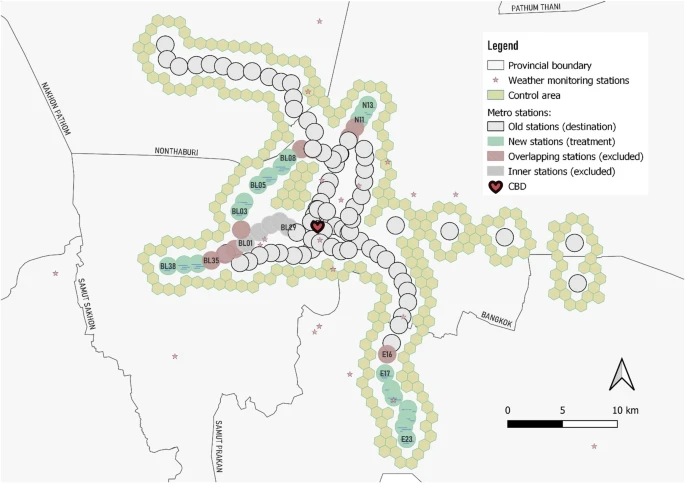
Journal Article - The impact of the Bangkok metro expansion via Big Taxi GPS probe data
Direct Article Link or click on the image below.
Monday, September 04, 2023
Sunday, November 06, 2022
Tuesday, October 11, 2022
Thursday, July 01, 2021
Tuesday, March 25, 2014
Over 1000 Fell Sick due to Air Pollution in Bankok, in 5 days (March, 2014)

From the National News Bureau of Thailand
According to Public Health Ministry Permanent Secretary Dr Narong Sahametapat, authorities have been successful in extinguishing the fire that broke out at a garbage landfill in Samut Prakan Province. He however said the fire had caused dust particle levels to exceed the safety standards of 120 micrograms per cubic meter, forcing families living near the site to evacuate.
Approximately 1,200 people reportedly fell ill during March 16-22, when the situation was severe, with most of victims suffering from eye, nose, and throat irritations.
He further disclosed that a 20-month-old baby had to be treated for lung infection. Fortunately, it was just a minor infection and the baby has already been released from the hospital.
Saturday, December 15, 2012
Nearly 400,000 Bangkok Commuters are Suffering from Respiratory Diseases Due to Air Pollution
According to the BMA's medical division, the number of people suffering from respiratory diseases such as asthma and allergies has risen drastically over the past seven years, with about 20,000 to 30,000 Bangkokians developing symptoms every year.

Traffic in Bangkok is getting worse thanks to the government's first-car tax-rebate policy. As of October 31, car registrations in Bangkok had revved up to 7,384,934, of which 296,553 were for new cars bought under the first-car policy.
Though the number of cars registered has risen this year, the Pollution Control Department's director general Wichian Jungrungreung said the quality of air in the capital was still "good" and that the number of particles smaller than 10 micrometres had reduced over the past two years.
Read More at the Nation, December 15th, 2012

Traffic in Bangkok is getting worse thanks to the government's first-car tax-rebate policy. As of October 31, car registrations in Bangkok had revved up to 7,384,934, of which 296,553 were for new cars bought under the first-car policy.
Though the number of cars registered has risen this year, the Pollution Control Department's director general Wichian Jungrungreung said the quality of air in the capital was still "good" and that the number of particles smaller than 10 micrometres had reduced over the past two years.
Read More at the Nation, December 15th, 2012
Monday, August 31, 2009
Pollution Due to Trucks - Gross Polluters in Bangkok
 As part of the DIESEL program (Developing Integrated Environmental Strategies for Evaluating Land Transport) in Bangkok, a series of surveys were conducted to understand the driver behaviour and driving cycles for the heavy duty vehicles (HDV) and the light duty vehicles (LDV). Following the surveys, approximately 250 vehicles, including a mix of manufacturers, age, and fuel quality, were tested for emission rates for the primary pollutants.
This study was supported and funded mutiple agencies and primarily lead by a teams from the Pollution Control Board in Bangkok and the World Bank in Washington DC, USA. The final report was dessiminated along with summary of emission factors at a workshop in June 2008 in Bangkok.
The emission tests emphasized the importance of going after the gross polluters in the fleet for effective management of the emissions in Bangkok. The three tables below presents an analysis of the emission tests for the three categories light duty vehicles, buses, and trucks. The total emissions (in gm) presented for each of the category represent the sum of all the emission factors measured and used here to estimate the fraction of the gross polluters among the fleet.


For example, for the light duty vehicles, the 24 percent of the vehicles are (9 out of 38) are polluting the most contributing approximately 46 percent of the emissions. A direct abolishment of the gross emitters will result in a faster reduction of fleet emissions.
Similarly, for the buses and trucks, where the average fleet age is high, the percentage of vehicles polluting the most is high. Among the heavy duty trucks, 15 percent of the fleet contributes to approximately 45 percent of the emissions. It is important to note that this is based on the sample used for the emissions testing, which was assumed representative of the ~3.9 million vehicles on road in Bangkok.
The analysis provided a basis for strategy development for in-use old and incoming new vehicles, which is detailed in the DIESEL final report.
Also see
Thursday, January 29, 2009
Air Quality Monitoring in Asian Megacities
 For air quality analysis, monitoring of various pollutants is very crucial for public health, compliance, and regulation. Here are some links to air pollution monitoring data from Asian megacities.
- Delhi, India
- Central Pollution Control Board, New Delhi, India
- Andhra Pradesh Pollution Control Board, Hyderabad, India
- Maharashtra Pollution Control Board, Mumbai, India
- West Bengal Pollution Control Board, Kolkata, India
- Karnataka Pollution Control Board, Bangalore, India
- Pollution Control Department, Bangkok, Thailand
- Air quality in Chinese cities, VECC-MEP, China
- Environmental Pollution Department, Hong Kong, Hong Kong
- Bureau of Environment, Tokyo, Japan
- Pollution Watch, Kathmandu, Nepal
- National Environmental Agency, Singapore
- Air Resource Management Center, Colombo, Sri Lanka
- Department of Environment, Malaysia
Subscribe to:
Posts (Atom)