Air quality modeling (AQM) is “data management” and the goal of this exercise is to support clean air action planning and implementation. This data provides us with the knowledge to validate the progress made or not made from various emissions management programs in space and time. All this data further strengthens the dialogue between data generators, data consumers, policy makers, and the public.
In this working paper, we refer to AQM following the classical modeling path and we reviewed the progress made by the modeling community, identified some research gaps, and proposed some line items to extend India’s air quality modeling efforts (content-wise and institutionally).
Why monitoring is preferred over modeling?
Many papers published on India’s air quality focus on monitoring-based research, accounting for approximately 63% of the pooled total. When papers utilizing newer methods, such as satellite data and information technology (including AI/ML-based approaches), are included, this share rises to 77%. In contrast, only 6% of the papers showed specific discussion on air quality modeling (involving chemical transport models).
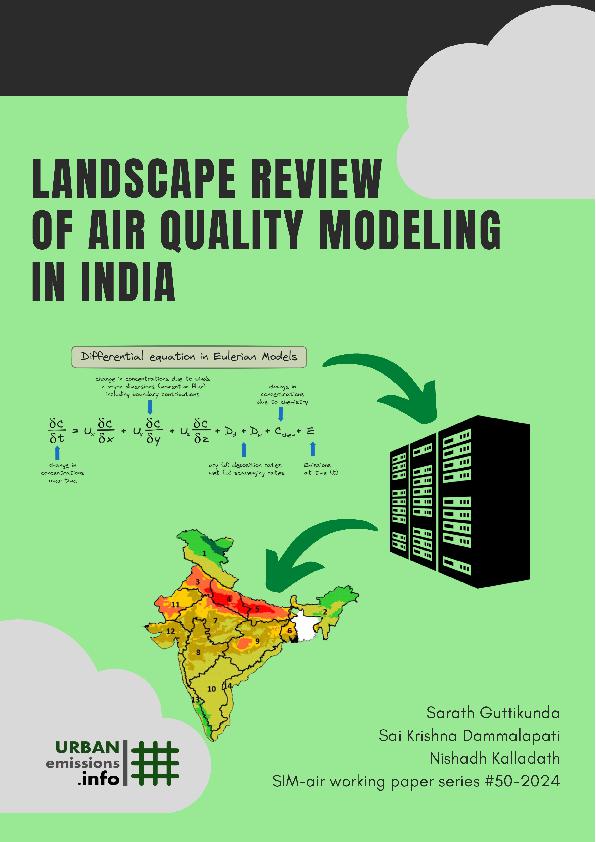
Direct Article Link or click on the image below.
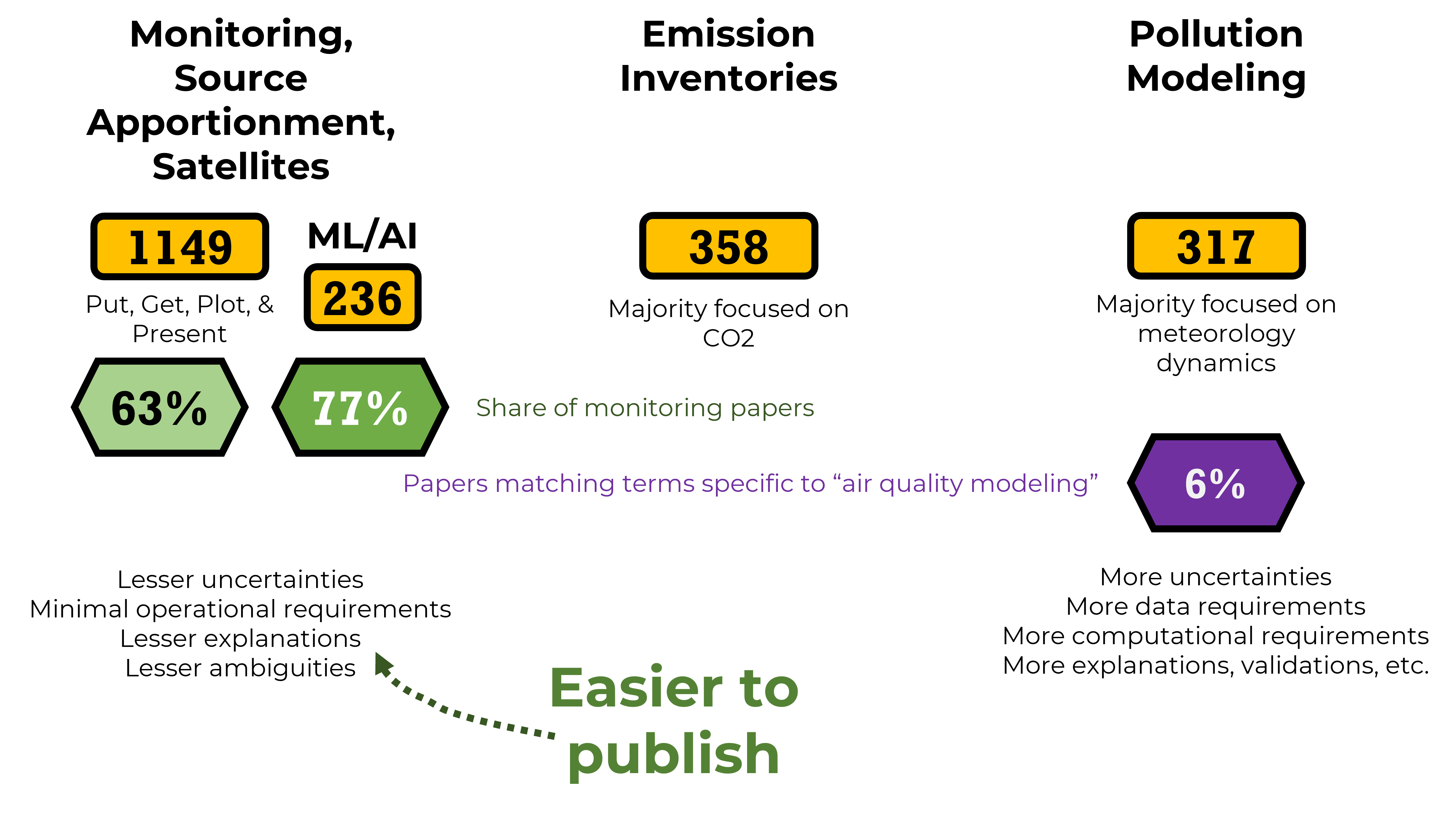
This reflects a clear preference for monitoring studies over other aspects of air quality research, such as emissions modeling, dispersion modeling, or receptor-based analysis. A subjective conclusion we draw from this trend is that publishing monitoring-focused journal articles tends to be easier compared to other more complex (and data involved) components of air quality modeling.
Monitoring studies often involves fewer uncertainties and minimal operational requirements, making them simpler to conduct and present. These studies typically follow a straightforward approach: set up monitoring instruments, collect data, plot results, and discuss general trends. This method requires less explanation of methodologies or interpretation of ambiguous results, as it revolves around direct measurements. In contrast, modeling studies require more complex data interpretation, deeper technical expertise, and often involve higher uncertainties due to the need for assumptions and predictions. The relative simplicity and clarity of monitoring-based research, therefore, may contribute to its higher representation in published literature on India’s air quality.
This observation regarding the prevalence of monitoring-based studies is in no way intended to downplay the complexity involved in air quality monitoring itself. In fact, monitoring requires a high level of technical expertise in setting up and operating the instruments, as well as rigorous quality assurance and quality control (QA/QC) procedures to ensure the accuracy and reliability of the data. The challenges of maintaining equipment, ensuring proper calibration, and interpreting the data are significant and require substantial knowledge and technical skill. However, the conclusions here are drawn specifically from the path to publication, where monitoring studies tend to face fewer hurdles compared to other more intricate research areas like emissions or chemical transport modeling. In other words, this also highlights the academic pressures to publish more and faster.
****
On one side, the need for operational training on classical air quality modeling will remain a priority for at least the next 10-20 years, institutionalizing the known chemical transport models and building a new crop of researchers and practitioners, who operate these models without fear of data.
The other side of the challenge is building localized emission inventories and consolidation of these inventories at the national and urban scales. At the time of this working paper, India still does not host an official consolidated emissions inventory to support air pollution modeling at any scale (national and urban airsheds).


No comments:
Post a Comment