Tuesday, November 01, 2016

Why Delhi's Plan for Air Filters at Traffic Intersections is a Red Herring

Imagine a sci-fi dystopia wherein the world’s pollution has breached all kinds of limits and people are walking around with glass jars and clean-air tanks on their backs; sitting in their offices or homes, where every cubic meter of air is filtered of all harmful pollutants; or even a big bubble covering a cricket stadium where the air is filtered for all to enjoy the game. All these scenarios have one thing in common – the volume of air under consideration is confined and under full control of the user or the operator. There is one inlet for air, through the filter, and the outlet is into the glass jar, the room or the stadium; not to a traffic intersection where the flow of air is not in anybody’s control.

Air pollution in cities is largely a symptom of insufficient urban planning, whether due to waste burning, traffic or industrial emissions. The only way to address it is through looking at the principal sources and finding ways to reduce pollution at their level. It takes planning, inter-agency cooperation, good governance and political will, so proposing solutions that only mitigate it at a small scale (like traffic intersections) are not, and will not be, sustainable. They are ineffective at best, and waste valuable resources that take away from working towards a constructive solution. If the government is at all concerned about reducing air pollution, it needs to plan ahead, well in advance, and not find salves that appear to be proactive on the eve of the pollution (i.e. winter) season. We already know that every winter, starting around Diwali, Delhi implodes with rising pollution affecting most of its 20 million residents. Let’s be prepared for it next time by doing something that actually reduces it at the source.

Read our full commentary @ the Wire

No Parking Space for New Buses in Delhi

The state government was to have inducted 3,000 buses by now to check air pollution in Delhi. But with the transport department pleading that there was no depot space available for any additional fleet, it is unlikely that public transport will have a role to play in improving air quality this winter.

The Supreme Court-appointed Environment Pollution Control Authority recently notified the court that the DDA had identified 68 acres that could accommodate 1,100-1,600 buses. EPCA said, therefore, that non-availability of land for bus depots wasn't a concern any longer and that Delhi government could immediately acquire a thousand buses. The EPCA note was also sent to the LG, the chief minister and the transport minister.

Delhi will have a far lower number of buses this winter also because of the various procedural delays in acquiring new buses. As of now there are around 5,600 public transport buses when the capital is reckoned to need 11,000. To make things worse, there has been a steady decline in vehicle fleet since 2012-13, with many buses being retired due to age.

Read the full article @ Times of India

Monday, October 31, 2016

Globally 600,000 Children Under Five Years Die (UNICEF)

“Air pollution is a major contributing factor in the deaths of around 600,000 children under five every year – and it threatens the lives and futures of millions more every day,” said UNICEF Executive Director Anthony Lake. “Pollutants don’t only harm children’s developing lungs – they can actually cross the blood-brain barrier and permanently damage their developing brains – and, thus, their futures. No society can afford to ignore air pollution.”

The study also examines the heavy toll of indoor pollution, commonly caused by use of fuels like coal and wood for cooking and heating, which mostly affects children in low-income, rural areas. Together, outdoor and indoor air pollution are directly linked to pneumonia and other respiratory diseases that account for almost one in 10 under-five deaths, making air pollution one of the leading dangers to children's health.

Children are more susceptible than adults to both indoor and outdoor air pollution as their lungs, brains and immune systems are still developing and their respiratory tracks are more permeable. Young children also breathe faster than adults, and take in more air relative to their body weight. The most disadvantaged, who already tend to have poorer health and inadequate access to health services, are the most vulnerable to the illnesses caused by polluted air.

Read the full press release @ UNICEF

Sunday, October 30, 2016

Wednesday, October 26, 2016

ESCAPE - Study Links Hyper Tension to Air Pollution

People who live in areas with polluted air increase their risk for developing hypertension, a leading risk factor for the development of heart disease. Known as high blood pressure, the hypertension study is the largest of its kind to establish the deadly link. A recent study looked at hypertension in 41,000 people in five different countries – Norway, Sweden, Denmark, Germany and Spain – for five to eight years. It is part of the long-term “Europe Study of Cohorts for Air Pollution Effects,” known as ESCAPE, which focuses on health problems associated with pollution.

At the hypertension study, beginning in 2008, none of the participants reported having high blood pressure or taking medicine to control it. By 2011, 6,200 people reported having developed hypertension and started taking blood-pressure lowering drugs. Most lived in urban areas where air pollution is highest. Air pollution is measured in micrograms of particulate matter per cubic meter. The researchers found that for every five micrograms per cubic meter of particulate matter, hypertension increased by one-fifth or 22 percent in people living in the most polluted areas.

Epidemiologist Barbara Hoffmann, who works for the Center for Health and Society at Heinrich-Heine University in Germany and led the study, says many of these cases of high blood pressure could be prevented. “So this is a very important result if you can see that something that you can actually change. I mean we can actually reduce air pollution, can have such an influence on such an important health outcome,” said Hoffman. The findings were published in the European Heart Journal.

Read the full press release @ Voice of America

Improving Power Generation Efficiency in India

India, like any other developing country, cannot overlook the pivotal role of the power sector in fuelling its overall development. All other sectors require a constant and reliable supply of electricity for the economy to function and grow. What sets the country apart though is the fact that it is the fifth largest producer and consumer of electricity with a capacity of 302 gigawatts (GW). From a meagre 1,743 megawatt hour (MWh) in 1950-51, the gross electricity generation boomed to 278,733 MWh in 2015, yet India is not a power surplus country even in the present coverage where around 1/4th of its total population is still deprived of access to electricity.

Currently, the estimated average gap between supply and demand of electricity (peak demand) is about 14%. The transmission and distribution losses are estimated between 26% and 32%. With rapid urbanization and industrialization, this gap is bound to rise fast. The distribution of power generation through different sources, however, is uneven. The thermal power contribution to this is around 63%, followed by hydropower contributing around 25%. The share of nuclear power is the smallest with 3%, and the power generation through renewable sources contributes the remaining 9%. The distribution of power generation amongst various states and regions in India is also highly uneven.

One of the ways to improve the efficiency of an existing thermal power plant can be by reducing this consumption by installing latest technology and infrastructure. For e.g. ensuring that the plants are equipped with the variable frequency drive so that the plant uses less electricity while running on half-capacity mode. Thirdly, the maintenance time and volume needs to be cut down.

There are several areas on which to focus for e.g. reducing flue gas heat losses, improving the air pre-heater seal, optimization of turbine steam parameters and operation, using boiler feedwater pump turbine and flexible heat regenerative technology together with maintaining high efficiency. Moreover, appropriate IT organizational structure should be developed along with management information services (MIS). There is also an urgent need for the development of IT modules to cater to various functional requirements such as computerized maintenance management system (CMMS), materials and stores management system (MSMS), operation plant performance management system (OPPMS), business planning module, finance and accounting (F&A) and human resource development modules etc.

Promotion of energy conservation and increased use of renewable energy are the twin planks of a sustainable energy supply. In an article, titled 'Biomass gasi?cation for decentralized power generation: The Indian perspective', the authors Buljit Buragohain, Pinakeswar Mahanta, Vijayanand S Moholkar of the Centre for Energy, Indian Institute of Technology (IIT), Guwahati, claim that the vast potential of biomass power remains almost unused, and there is an urgent need of utilization of this resource through more efficient technologies such as biomass gasi?cation. Likewise, there is a need for implementing newer fields of technological studies such as energy systems engineering work to provide a methodological scientific framework to arrive at realistic integrated solutions to complex energy problems, by adopting a holistic, systems-based approach, especially at the decision making and planning stage.

Read the full article @ Economic Times

Tezpur is the Among the Clean Cities

The small city of Tezpur in the tea region of Assam has become India’s cleanest city and its residents are breathing easier because of it. Here, since the last WHO air-quality report in 2014, PM10 pollution, caused by dust particles, has been reduced by close to 85 percent — a vast improvement in a country that has been focusing on rapid urbanization and industrial development. The residents of Tezpur have only themselves to thank for this. Over the years, they’ve been making conscious efforts to go green. Trees are being planted, waste is segregated into either organic and inorganic, trucks are being re-routed out of the city center, and residents are speaking up about their environment. But crucially, the local industry has cut back on or switched entirely away from coal to cleaner energy.

CNN’s “Eco Solutions” visited the Matiapahar tea plantation during the harvest season and witnessed the change first hand. Here, heavy duty machinery that had been powered by coal now runs on liquefied petroleum gas. Even though LPG is produced from fossil fuels, it produces virtually no particulate pollution compared to burning coal. In other words, it’s basically smoke free.

Arabhinda Bhattacharjyam, the manager at Matiapahar Tea Garden, tells us it’s a win-win for the environment, the workers inside the factory, and for the product itself. “We have used liquefied petroleum gas since 2002,” he says. “Now the quality of the tea is much better. Now we are selling good quality tea in the market.” With cleaner air, the quality of the tea improved and the price of tea jumped from 45 to 67 rupees per kilo – making LPG a sound environmental and business decision. In fact, the move has become so popular that 40 tea gardens in Assam have entirely dispensed with coal, using LPG as their main source of fuel. These efforts go beyond tea gardens. Stone cutting mills and waste paper mills, some of the main industries of Tezpur, have found ingenious ways of controlling air pollution. In the former, water is sprinkled every six hours to contain dust particles. In the latter, rice husks – which are locally available, 30 percent cheaper than coal, and do not emit a high amount of particulate matter – are being used as fuel.

Read the full article @ The Diplomat

Anti Fire Crackers Campaign in Delhi

Environment Minister Imran Hussain on Tuesday reviewed the action being taken by various stakeholder departments and agencies including the Environment Department, Delhi Pollution Control Committee (DPCC), Delhi Police, Licensing Unit, Petroleum & Exposure Safety Organization (PESO), District Magistrates/SDMs etc.

The review was conducted to make the 'Anti-Fire Crackers Campaign' successful, to control air and noise pollution effectively due to fire crackers during the forthcoming Diwali festival. The meeting was attended by senior officers of Environment Department and Delhi Pollution Control Committee (DPCC) along with SDMs of all districts who are the designated authority as per notification under Noise Pollution Rules 2000 and also by Senior Officers of Delhi Police and PESO.

The Delhi Government has constituted 11 teams (district wise) headed by area SDMs and assisted by Executive Engineers (DPCC) to curb the sale of illegally imported/Chinese fire crackers in the market, which are the main source of spreading toxicity in the air during Diwali.

 
More @ India Today

Monday, October 24, 2016

Dusty Roads in Hyderabad

Air pollution levels in the city have become a cause for worry because this is one of the major parameters in the Centre’s Swachh survey of India. The city records above permissible limits in respirable suspended particulate matter (RSPM) due to dust from under-repair roads and carbon monoxide pollution caused by vehicular exhaust.

Of the five parameters on which air pollution is judged, Hyderabad does poorly in two while rating as average on the others. In the 2015 Swachh survey, Hyderabad stood at the 19th position. “The other parameters include sulphur dioxide and nitrous oxide (gases emanating from industrial sector). On this front, the city is in the safe zone as the two gases are within standard levels. The major concern is RSPM which is the result of the dust from roads that enters the bloodstream and causes various lung-related diseases and eye problems,” said environmentalist W.B. Prasanna Kumar,

The second issue of major concern is the carbon monoxide from vehicular emissions and from burning of leaf litter. “There is no separate disposal system for leaf litter. The waste, when burnt, releases carbon monoxide. RSPM and carbon monoxide are above the standard limits which is a matter of concern for us,” Mr Prasanna Kumar said.

Read the full article @ Deccan Chronicle The modeled source contributions to the ambient particulate pollution (PM2.5) in Hyderabad district is presented below. The calculations are conducted in forecast mode. More district reports @ India Air Quality.Info


Tuesday, October 18, 2016

# No Cracker Diwali

A message from Public Health Foundation of India

Air Quality in Nagpur (Maharashtra, India)

While industries, power plants, mines and vehicles are blamed for increasing exposure to air pollution, there are many lesser-known sources which are significantly poisoning the quality of air. Virendra Sethi, professor at Centre for Environmental Science and Engineering, Indian Institute of Technology, Bombay, whose 40 research papers have been published in various international journals, talks about what really is adding to rural and urban air pollution.

It is a myth that pollution is completely dependent on population or number of vehicles in a city. There are various other factors that degrade a city's ambient quality of air. In case of Nagpur, it is surrounded by thermal power stations in Koradi, Khaparkheda, Butibori, Mauda and industries in Hingna and Butibori. Depending on the wind direction, pollutants from all these sources come in the city, this increasing it pollution levels. Read the full article @ Times of India

Below are some extracts for the city of Nagpur, from the air quality forecasting system for India.


Details of the emission fields and modeling architecture is available @ http://www.indiaairquality.info


Sunday, October 16, 2016

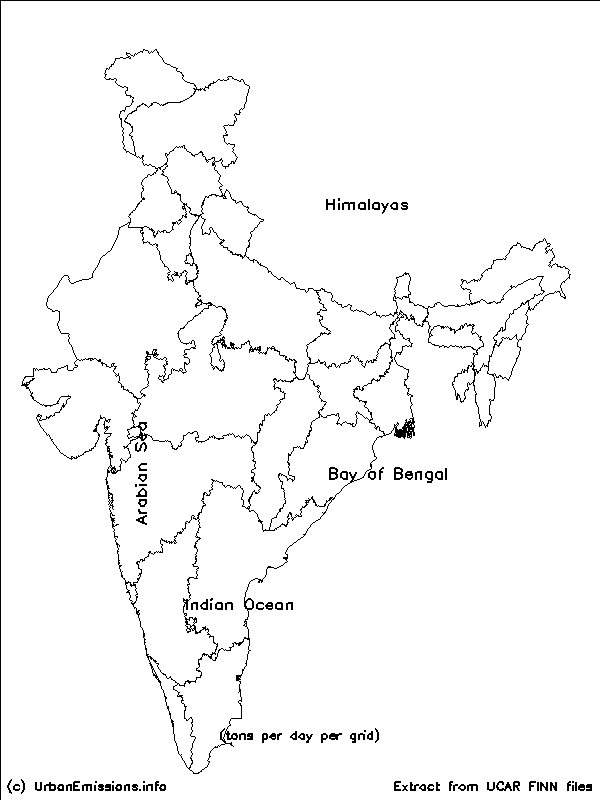
Fire INventory from NCAR (FINN) - A Daily Open Fire Emissions Extracted for the Indian Subcontinent

Open biomass burning makes up an important part of the total global emissions of greenhouse gases, reactive trace gases, and particulate matter. Although episodic in nature and highly variable, open biomass burning emissions can contribute to local, regional, and global air quality problems and climate forcings. The Fire INventory from NCAR (FINN) model provides high resolution, global emission estimates from open burning; these emissions have been developed specifically to provide input needed for modeling atmospheric chemistry and air quality in a consistent framework at scales from local to global. The inventory framework produces daily emission estimates at a horizontal resolution of ~1 km2. The product differs from other inventories because it provides a unique combination of high temporal and spatial resolution, global coverage, and estimates for a large number of chemical species. Read the full description of the product @ NCAR

Below is an extract of the daily emissions file covering the Indian Subcontinent. More details on how we are utilizing this product for air quality analysis and forecasting is @ http://www.indiaairquality.info

CNG in India

In its efforts to move towards a gas-based economy, the NDA government plans to increase natural gas contribution towards India’s energy mix to 15% from the current 6.5%. Read the full article @ VCC